
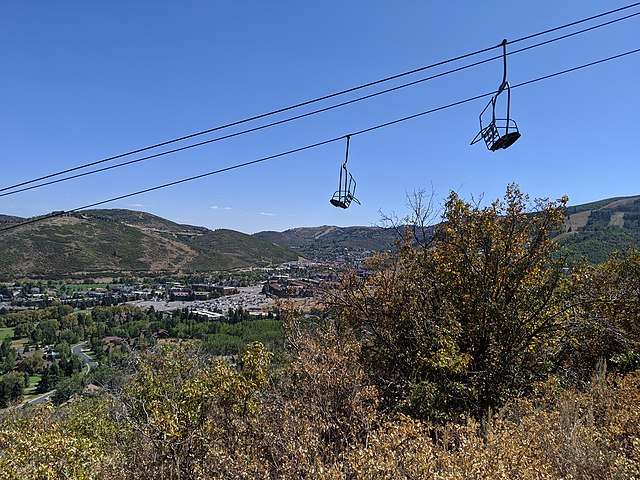
 in Vail
No, you didn’t miss out on the lowest EPIC prices of the season
If you are like me, you are trying to determine whether you missed out on the lowest prices of the season at Vail Park City Mountain Resort. Vail’s marketing said May 30 was the day to lock in the lowest prices of the season.
It is now, May 31st. Well, at least for the Epic Local’s Pass, today’s price is the same as yesterday’s price. You may have missed out on a Buddy Pass or two, but your annual rate didn’t change today. Hallelujah, I suppose.
In reality, many of us are trying to decide whether we want to pony up to pay Deer Valley prices next year. Most would say that Alterra didn’t screw up their local resort as much as Vail did. However, what to buy is a question you can only answer for yourself.
That said, I will say that Snow Basin, only an hour away, has been fabulous every time I have visited before March 1st. Check it out.
So, what are you going to do next year?
The good news is you can still buy a Vail local for $626. The bad news is that Deer Valley costs four times as much… but you get what you pay for.
 in Schools
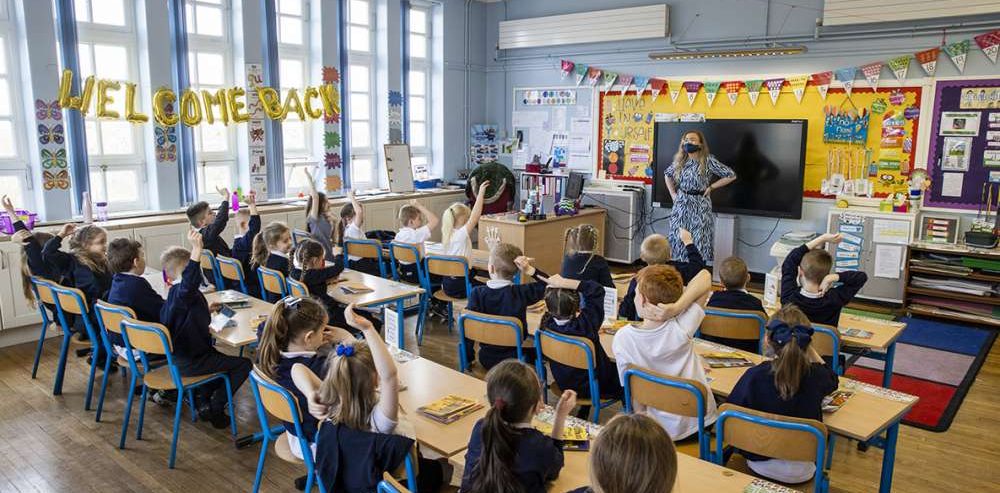
Park City school class sizes may be a problem next year. It’s time to reach out to the Superintendent and the School Board.
Two weeks ago, I made the plea for parents to register their children for next year at Jeremy Ranch Elementary. Since that time I have heard from teachers and administrators across the district who are sounding warning bells. There are genuine concerns from educators that some elementary classes in Park City schools could have 35 students in a class.
This stems from a number of teachers who appear to be leaving and other teachers who are not having contracts renewed. It’s not likely from an influx of students, as our school numbers have been decreasing.
Now is the time to address this. If you have an elementary-aged student, I would encourage you to reach out to the Park City School Board and Superintendent Jill Gildea and ask what your estimated class size will be next year. As always, please be polite. No one likes to be yelled at, or be accused of malfeasance. However, I do believe our school leaders need to hear from parents that large class sizes are unacceptable.
You’ll likely hear back that the district won’t know until the final registration numbers are in. However, it seems fair to ask the question, “I know things may change, but what does it look like now?” We as parents need to ask this hard question and receive answers. We need to apply the pressure that lets our leaders know this is important. Hopefully, by asking the question now, the district will do everything in its power to keep class sizes at a level where children can learn, teachers don’t get more burnt out, and principals and staff aren’t putting out fires all day, every day.
Here are our Park City School Board members:
If you don’t know what district you are in, you can click on the District Number on this page. It will show you a map.
If you’d like to reach out to Superintendent Dr. Gildea and voice your concerns, her email is:
In a best-case world, the district would publish an estimated class size for each class, in each school for next fall.
What you don’t want to happen is for your seven-year-old to show up on their first day of second grade and have forty kids in their class. By asking the simple question “how many children will be in my child’s class next year?” we can hopefully influence our schools to ensure class sizes are manageable.
Hi, I’m Josh Mann. I created the Park Rag in 2012 to tell stories like these. This year, I am running for Park City School Board. I believe that through open communication, we can build a stronger community. Thanks for stopping by.
 in Schools
Is this the type of behavior we want from a member of the Park City school board?
On Tuesday KPCW published an article titled “Candidates decry opponent’s appointment to Park City school board.” One of those candidates was me, Josh Mann. I, along with Meredith Reed and Mandy Pomeroy, are running for Park City School Board. Ms. Reed and I felt appointing one of the three of us to the board, didn’t serve the democratic process. Ms. Pomeroy disagreed and applied.
I have no problem with Ms. Pomeroy choosing another path; however, how she has conducted herself brings up larger questions.
Ms. Pomeroy could have respectfully disagreed and stated why she felt it was important to apply. Instead, she chose to attack Ms. Reed and me and color our opinion as uninformed and uneducated. In a Park Record editorial she attempted to explain how a bill becomes a law, that because the state legislature has a code it guarantees a democratic process, and that we should just do a “quick Google search.” In truth, she completely missed the point. She didn’t listen, she didn’t ask questions, and she didn’t understand.
Furthermore, In KPCW’s article, Ms. Pomeroy says “the decision by Reed and Mann not to apply for the interim appointment ‘speaks volumes about how they truly feel about their qualifications for the position.’ Ms. Pomeroy doesn’t know me. She doesn’t know my background. I don’t believe we have ever met. Yet, she knows how I feel about my own “lack” of qualifications. Yes, for you who are reading, she also likely knows how you feel about almost everything, as well. That said, her criticism does offer me a chance to talk about my qualifications.
Let’s start with the high-level duties of the school board per school district policy 2005. These are the things our school board should be doing.
- The Board has the legal power and duty to do all things necessary for the maintenance, prosperity, and success of the schools, the promotion of education and to exercise all powers given by statute.
- The Board shall determine what conditions are essential to the successful management, good order, and discipline of the schools and the rules required to produce these conditions.
- The Board shall establish tax rates each year prior to June 22 and submit the proposed rate to the board of commissioners of the county in which the District is located.
- The Board shall prepare, adopt, and file a budget for the next succeeding fiscal year with the board of commissioners of the county in which the District is located prior to June 22 of each year.
- The Board may acquire and hold real and personal property in the name of the District.
- The Board may close the school(s) or suspend operation if necessary.
- The Board will evaluate the superintendent and the business administrator.
Here is my background:
- I have a Business major with an emphasis in Psychology from the University of Kansas. My first job was working for the accounting firm Ernst & Young. I have business and accounting skills.
- I am a C-level executive for a software company. I am responsible for planning, reviewing, and directing our company’s budget.
- I have followed, commented on county officials, and written about County taxes since 2012. I not only understand how the tax system works in Utah, and I will treat each dollar spent as my own. Property taxes are rising, and will only rise more in November. I guarantee that I will be a responsible steward of your money.
- The board must determine conditions that are essential to management, order, and discipline in our schools. In the last year, the school district has defied the County Attorney on mask laws, not done much related to a swastika and hate speech in a Jewish teacher’s classroom, and presided over at least two cases of unreported rape and one case of child abuse. Nothing appears to be being done at the school board level. My background shows that I will not allow that attitude to go forward. We need a change of culture.
- The board is required to evaluate the Superintendent and Business Administrator. My opinion on Todd Hauber, the current Business Administrator, is clear. If you need to understand the business side of the school district, he knows it all. A week ago I had questions about the district’s lease revenue bonds ($42 million). He spent 20 minutes after the school board meeting answering my questions and explaining how the interest is calculated. As an outsider to the district, I feel Todd Hauber is an A+.
On the Superintendent, the jury is out. Dr. Gildea has a total compensation of $415,000 a year and she runs seven schools, amid several scandals. That is more compensation per student than any other district in the state. The question is whether we are getting good value for our money. We need to answer that question.
So, I would hope you would agree I am qualified. I care passionately about this and have for more than a decade.
The bottom line is that Ms. Pomeroy is already showing how she will behave as a member of the Park City School Board. They may just be sound bites, but she is demonstrating a tendency toward not listening, not conducting herself respectfully, and jumping to conclusions. These are issues that many in our community have with some members of our current school board.
I believe we need to change the culture of the Park City school board.
If you like the current direction of school board, I would encourage you to vote for Mandy Pomeroy. You’ll get more of the same.
If you want something different, please consider me, Josh Mann, for school board. I have a proven record of asking questions, not being bullied, and listening. I am committed to change.
If I am not your cup of tea, please consider Meredith Reed, who is also running for the school board. Yes, we are running against each other, but I believe she also wants to make our schools better. More information about Ms. Reed can be found here.
Ms. Pomeroy has effectively told me I am uneducated and unqualified. She has told me to “Google It” multiple times when trying to counter why I didn’t feel it was democratic to be appointed to the school board.
If that’s the behavior you want in someone responsible for educating our children, then she is a great choice for you.
If you want someone different, I would appreciate your support in June during the school board primary.
Together, we can make our school district better for our children and the entire community.
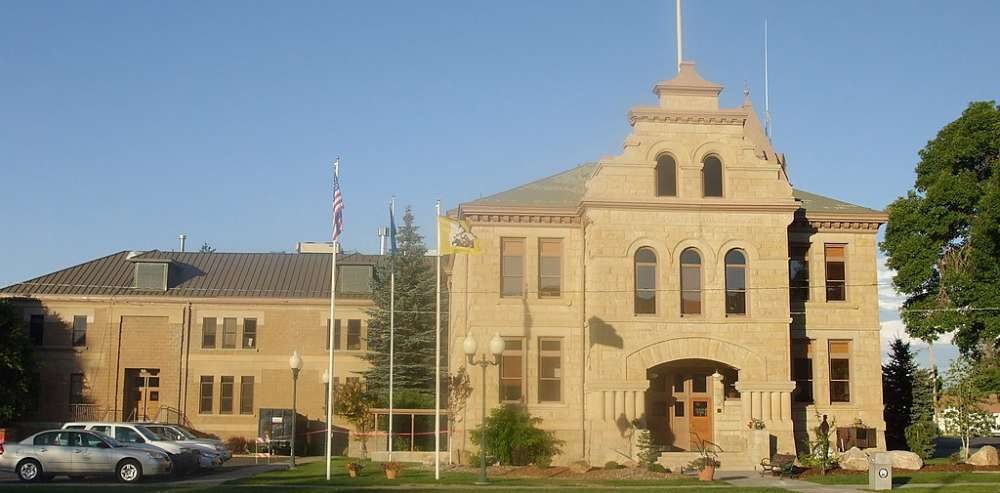
A light agenda for today’s Summit County Council meeting
As is typical of Wednesdays, the Summit County Council is meeting today in an open session. If interested you can join the meeting via zoom at around 4:25 PM.
Today’s larger topics include:
- Discussion and approval of the 2023 Behavioral Health Area Plan. The report on this can be viewed here.
- Creating the Summit County Open Space Advisory Committee.
- A public hearing about updating telecom ordinances on the east and west side of the county. This may interest some in the Snyderville Basin as it redefines where telecommunication facilities can be built and under what zoning. It’s one of those things most people don’t care about until they have a reason to care, but you may have a reason.
- Public input, as usual, will be at 6 PM. You can provide feedback about any topic that is not on the agenda or the subject of a pending land use application.
 in Schools
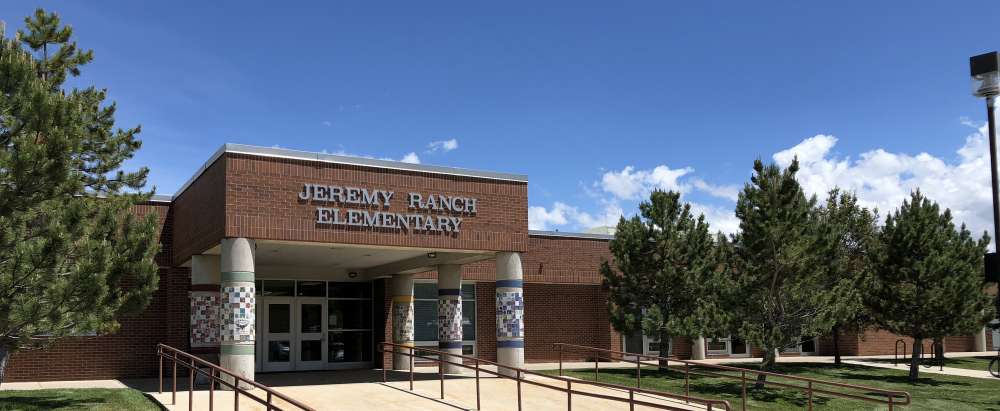
Register your kids for Jeremy Ranch now to help decrease class sizes
Each year, it’s important to register your children for Park City Schools to help the district plan for the next year. However, this year, if your child attends Jeremy Ranch Elementary it is more important than ever to REGISTER NOW.
Word on the street is that the older grades may not have enough sections to maintain adequate class sizes. The school needs to know the number of kids so they can do everything they can to have enough classes for each grade. This is compounded by the number of teachers that appear to be leaving our schools this year. So, it is not only assigning a teacher to a class but also finding that teacher. That is not easy.
Here is a hypothetical example. Let’s take fifth grade at Jeremy. This year there were two DLI French classes and three STEM classes in fourth grade. For ease, let’s say that’s a total of 100 kids (it’s probably a little bit higher) moving into fifth grade. If next year the school is only allotted teachers for two DLI and two STEM that means the DLI classes would again have 20 kids but the two STEM classes would each have 30 kids. That can be a lot, especially if there are behavioral issues a teacher has to deal with.
This example could also hold true for other grades and schools as well, depending on the makeup and enrollment.
As parents, we need to give our schools all the information they need, so they can go to bat for smaller class sizes with the district office. This could have a material impact on your child. So, if you haven’t registered, please do so now. Here is a link to the Park City School District’s enrollment page.
Hi, I’m Josh Mann. I created the Park Rag in 2012 to tell stories like these. This year, I am running for Park City School Board. I believe that through open communication, we can build a stronger community. Thanks for stopping by.
Tuesday’s special school board meeting for approving bonds
Well, there appears to be an emergency PCSD school Board meeting coming up tomorrow (Tuesday), but it’s not for the purpose I hoped. Regardless, let’s look at what’s on tap.
The only topic on the docket is approving the PCSD’s use of lease revenue bonds to facilitate $42 million in additional construction of our schools. So, what’s a lease revenue bond and how is it different from a normal bond?
First a caveat. I am not a finance expert. So, hopefully, this will generally get it right.
When the $79 million school bond was passed by voters in 2021, it was announced that the district would also seek $40 million in additional monies through a “lease revenue bond” which is a different type of funding vehicle. The $79 million bond is categorized as a government obligation (or GO) bond. A GO bond has to be passed by the voters and usually has a lower interest rate because it isn’t risky. That’s what the public overwhelmingly passed in November.
The lease revenue bond is different. It is more complicated. Effectively a government organization creates a “local building authority” or LBA. The LBA then issues bonds and the school district leases the land/facilities from the LBA. The lease payments provide security to the investors in the bond. These types of bonds typically require the school district (and the public) to pay higher interest rates in order to get the $42 million.
If you are worried about this second type of bond, you can attend/watch tomorrow’s meeting at 2 PM. There will also be a public hearing, scheduled for some date, after tomorrow’s meeting. Finally, the public can contest these bonds. However, here is what we know as of now about the proposed issuance:
- The maximum amount of bonds issued is $42 million.
- They can be issued as a series of bonds (i.e. $10 million here, $20 million there).
- The maximum interest rate that can be paid is 5% per year.
- Bonds have to mature within 21 years.
- After fees and other expenses, we have to receive 98% of the value of the bond (i.e. We issue a bond for $42 million and we have to actually receive at least $41.16 million that we can use for building.
The questions I would ask, if I were on the School Board are:
in Schools
Where is the emergency school board meeting?
As you are probably aware, seven Park City School District employees allegedly failed to report child abuse as required by law. This included one case where a boy’s penis was touched and two cases of rape. The Summit County District Attorney charged the school district with failure to report child abuse and stated that they came forward with charges before the investigation was done because an additional case occurred in the last week.
My question is where is the emergency school board meeting? Shouldn’t they be meeting NOW to help ensure that students are safe?
I just don’t understand. Yeah, they are in a mess. Yes, things should have been handled differently up until this point. Yes, there are legal ramifications. However, what we need right now is communication.
A problem has been identified. How are they addressing that problem? What are they doing to keep our kids safe?
That’s all I want to know.
 in Schools
A dark time for Park City’s children
Imagine you wake up this morning to the charges that seven Park City School District employees failed to report child abuse, which is required by law. These include one incident of a teacher allegedly touching a boy’s penis and two other alleged cases of rape. You may ask yourself, “Could this happen to my child, and would I know?” Perhaps more frighteningly you may wonder, “Has this happened to my child and I don’t know?”
Would you go to an amusement park if they were charged with violating safety requirements on their rides? Would you eat at a restaurant if they were charged with food poisoning? Should you send your children to school if it is likely that on three separate occasions (that we know of), school personnel didn’t report child abuse?
However, it gets worse, if possible. According to the Salt Lake Tribune, Summit County Attorney Margaret Olson decided to file charges, before the investigation was finished, because the school district failed to report another case last week — while the district knew it was being investigated. “I was troubled that the school district, knowing there was a pending investigation, still failed to report a case last week,” Olson said.
So, you are being investigated for not reporting child abuse, which is required by law. During that investigation, you allegedly don’t report more child abuse. So, you’ve forced the County Attorney to file charges immediately to get your attention and hopefully prevent future cases of child abuse. I feel like I am watching an episode of Cops, instead of commenting on our schools.
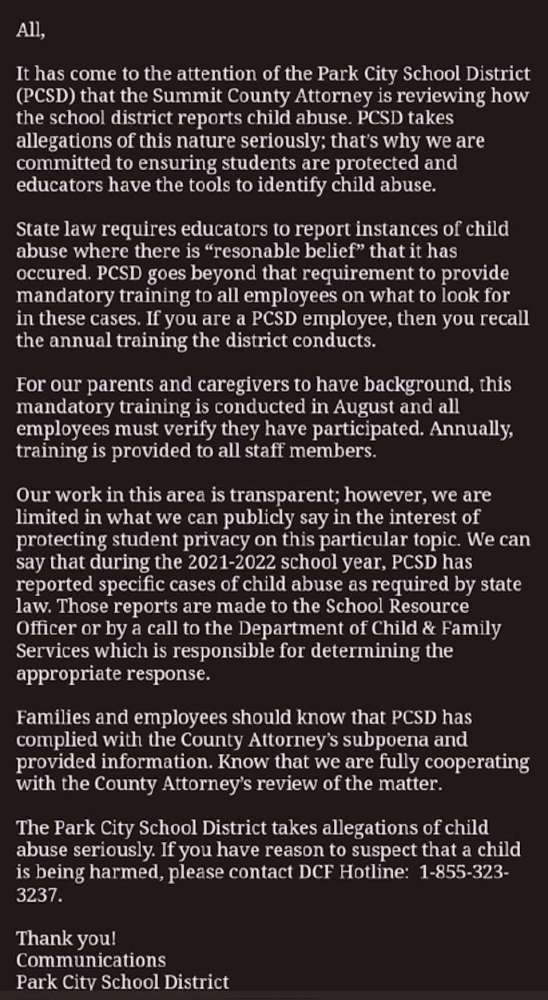
What was the district’s response? Here is an email sent out to employees:
My response to this is:
- The County Attorney is not reviewing how the district handles reporting of child abuse. She has charged the district with breaking the law. There is a difference.
- They say, “if you are a PCSD employee then you recall the annual training you receive.” I feel like I am reading Orwell. Teachers probably don’t need to be reminded of what they recall.
- They say, training is annual and employees have to acknowledge the training. I don’t believe the requirement is training. The requirement is that personnel report child abuse. Obviously, more needs to be done.
- They claim that the district has reported cases of child abuse in 2021-2022. Great. How many times did they not report cases in 2021-2022? Where is the promise of an internal investigation. Where are they committing to getting better?
- Finally, they comment that the district is cooperating with the County Attorney. Good choice. If they weren’t, I’d hate to see what would happen at this point.
This reads like a CYA memo. The truth is that this email and a similar email sent to parents are basically saying, “we did nothing wrong.”
Then we have the prepared statement from School Board President Erin Grady. “We take these allegations seriously and as always prioritize the safety of our students so that they can reach their academic and social potential. We ask that the public is respectful of the district administration and allows this process to play out before assuming any negligence or bad intent.”
We as a community may have been willing to let this “play out” until we found out that while the district was being investigated, another case of abuse allegedly wasn’t reported. If we let this “play out” who knows how many more non-reported cases of abuse there will be. Something needs to be done and done NOW. Even if the school district is ultimately found not guilty of these charges, what’s the harm in providing more focus on reporting and preventing child abuse RIGHT NOW?
It is fair to ask whether this is the responsibility of Superintendent Gildea or the Park City School Board. I do believe that employees are supposed to complete training and that they are supposed to acknowledge that training. Likewise, Dr. Gildea and the School Board aren’t omnipresent in every school at every moment. Yet, the buck has to stop somewhere. Someone is ultimately responsible. If the allegations are true, the employees who specifically should have reported the incidents are responsible. If this is an organizational failure, then the responsibility also goes to the highest levels.
County Attorney Margaret Olson provides an answer to that when she said their investigation has found “systemic and institutional failure.” That makes it fairly clear that the Park City School District, as a whole, has a problem.
Unfortunately, the effects of that problem rest on the shoulders of our most vulnerable — our children. Growing up in a place as wonderful as Park City should be a joy. For many, it probably is. However, it is our responsibility as adults to help those in need. It’s our job to look around the corner and take care of those people who can’t take care of themselves.
If children are being sexually abused … If they are being raped… If district personnel knew and didn’t report it … and our district leadership responds with, “teachers have annual training” and “allow this process to play out” then we have a real problem.
Worse than that, our children have a real problem. It’s one they have to try and live with every day.
It’s a tough time to be a kid growing up in Park City.
 in Schools
Survey highlights problems with the Park City School District
A group of Park City parents, teachers, and others created a survey on how our schools are doing. They sent the survey to teachers and other staff members on Valentine’s day. Approximately 80 employees responded to the survey and gave feedback on our school district. You can view the survey results here.
There appears to be some bristling within the district. School Board member Andrew Caplan called the survey a “hit-job.” My opinion is that any type of information is good information. You just have to take it for what it’s worth. Therefore, I wanted to share the survey results with our community.
If you read the survey in detail, you’ll find a variety of opinions. Educators seem to love their principals. People aren’t as happy with the School Board and Superintendent. Although, you’ll find supportive comments on both in the survey.
To understand more about the survey, I wanted to ask the creators of the survey questions. The survey was created anonymously, but Park City parent Kris Choi was part of the team that created it, and she was willing to talk about it. I wanted to know why she came forward and what she feels is important. She was kind enough to spend time answering a few questions:
Q: Why was the PCSD Stakeholder survey created?
Because we knew there was a need for this survey. Our kids’ teachers have been leaving our district for better jobs or to take early retirement in the last two years or so and we wanted to know what factors were contributing to the movement.
We scrubbed the district and Boarddocs websites for survey documents. We could not find even one from PCSD, going as far back as the early 2000’s, related to workplace satisfaction.
The only way to learn about how our employees are doing is to ask them directly.
Q: Some people are a little suspicious when something is anonymous. Why the anonymity?
Just as employees are operating in fear of retribution from district leaders, external stakeholders have the same fear. Many of us have experienced it personally already. We felt anonymity all around was the only way to get honest feedback and input. And that was actually confirmed by a teacher who wanted to know more about PCSD Stakeholders because said teacher was highly concerned that the survey was affiliated with the district.
Q: Why did you, Kris, decide to put your name on the survey?
Because the community needs to know that there are real people who care. So, for those in our community who have questions about the survey, I’m here as a representative of our group for any questions you might have.
Q: What types of people helped create the survey?
PCSD parents, volunteers, teachers, and professional advisors.
Q: Some people believe that the answers aren’t reflective of the entire school district. Why should the public trust the survey?
The survey was issued with the sole intention of creating a platform for honest, unfiltered, feedback from district employees. We expected a higher response rate than 18%, but given the fact that PCSD leadership discouraged participation at a 100% rate, that’s 18% of employees who still felt the need to offer honest, unfiltered feedback. The responses are indicative of serious issues that logically can be extrapolated to apply to the wider base.
Q: You stated that you received an 18% response rate. Is that good?
No. It’s a pretty low response rate. We aimed for and expected higher. However, about 28% or so employees could not even be queried due to incorrect or non-existent email addresses and bounce-backs.
What is more revealing than the response rate is that even AFTER district leaders discouraged employees from participating, 18% still completed the survey.
Q: Does the survey have a sound methodology?
Yes. We sussed out an appropriate vendor, built out and refined questions relevant to PCSD, employees, leadership, and the Park City community at large when it comes to employee workplace satisfaction. The survey was not constructed in a vacuum; rather, it was constructed with a good cross-section of stakeholders.
Q: There appear to be comments under each survey question. Are those all the comments received with the survey or were certain comments cherry-picked?
In order to maintain the integrity of the survey results, we had to include all comments as written. If we had deleted even one comment, that would have left room to question the integrity of the survey.
Q: School Board member Andrew Caplan described the survey as a “hit job” in a recent meeting. How do you respond to that?
That seems in keeping with Mr. Caplan’s character and conduct. This is not an audition for ‘The Godfather’ or ‘The Sopranos’— it’s a public school district. The board may not like the results of this survey, but these ratings and comments are from the very employees they are bound by public duty to support and protect.
Q: The survey showed both favorable and unfavorable things going on in the district. What did you consider the most positive and least positive results?
The most positive takeaways, as you see in the Summary and Conclusions of the results document, are:
- Most participants find their jobs challenging and meaningful
- They seem to have the base-level tools at their disposal (but also expressed that those tools could be and should be improved)
- They believe their skills are put to good use
- They have mutually respectful relationships with co-workers and immediate supervisors
- They are satisfied with the benefits PCSD offers
- PCSD principals, students, and parents received favorable ratings in most areas covered
The least positive takeaways are:
- Most participants either didn’t recall a comprehensive employee satisfaction survey the whole time they’ve been employed with PCSD. Sure, there have been smaller surveys once in awhile, but nothing like this that took a deep dive.
- They are stressed out and do not feel reasonably compensated
- Their work-life balance is undesirable–they are likely to be taking work home and losing quality time with their families
- They do not have opportunities for growth and advancement
- Conflicts in the workplace are not addressed promptly and professionally
- District-wide communication is not timely and transparent
- Serious issues (bullying, hate speech, etc.) are not addressed quickly, fairly, and professionally
- PCSD employees do not feel valued by the Park City community
- PCSD employees and leadership are not on the same page
- Employees overwhelmingly rated their PCSD Board members and Superintendent poorly in every category
- PCSD’s organizational structure is top-heavy, with much greater need for additional support staff in classrooms and much less need for high paying district officers
Q: 91% of participants said their job is meaningful to them. Could you tell from the survey what contributes to that?
It appears from the responses that our employees actually enjoy the type of work they do. Teachers enjoy teaching and, with the exception of specific experiences, they enjoy their students, co-workers, principals, and parents.
Q: 94% think their job is stressful. What did they say about that?
They elaborated that employees are not treated equitably. They do not feel supported, appreciated, respected, recognized, and valued by the district office and Board. They feel that the district office, Board, and Superintendent are operating in a vacuum and are disconnected from the schools. Their workloads are higher than they can reasonably manage. Certain favored employees are picked to be involved in decisions, while the rest feel that they are intentionally left out. Teachers have less and less time to prepare their educational lessons for students. People aren’t on the same page. Students are misbehaving more often. Teachers feel handcuffed by changes at the state level, too.
No reasonable person can expect great education under these circumstances. When teachers burn out, students ultimately suffer the consequences.
Q: 74% of respondents disagreed that PCSD employees are on the same page. Could you discern why?
The results indicate there is an extreme disconnection between employees at individual campuses and the district office and Board. District communication, or lack thereof, seems to be a pain point that inhibits people from operating with the same understanding. Transparency seems to be another pain point. Common goals are not achievable without common messaging. Without common messaging, a system wherein everyone works toward common goals and understanding is simply not possible.
Q: On almost every question regarding the School Board, more than 50% of respondents felt the board isn’t doing a good job. To what do you attribute that?
The results from this survey indicate that Board members are out of touch and keep PCSD employees at arm’s length. Some don’t even know who the Board members are or what they do. That’s a problem. It doesn’t help that the demeanor of the Board when it does engage seems very adversarial toward teachers and acquiescent to the Superintendent, the person they are supposed to regularly evaluate for effectiveness in her job. Checks and balances in a system cannot exist without understanding what that system needs. That isn’t lost on the employees.
Q: Looking at the responses to questions about the Superintendent, there were both positive and negative comments. Did anything surprise you with the responses regarding the Superintendent?
We were surprised by the sheer volume, depth, and detail of employee comments about the Superintendent, but not by the content. One point of note about the Superintendent that was not already known or suspected, is that she requires that she interview all job candidates herself. Given that the results indicate that she still has not met all our current educators, therefore cannot understand their needs, it is striking that she would insert herself in all school-level interviews. This practice significantly slows the hiring process and shows that she does not trust school principals to manage their own hiring process. The results also indicate that she selectively micro-manages and that she has developed cronyistic relationships.
There were positive comments that were surprisingly quick, generic, and without elaboration.
Q: Generally people seem to like their Principals. However, there are major concerns above that position. Could you tell what the principals are doing right that higher levels of the organization aren’t?
While there are concerns about specific principals, generally speaking, principals know more about how their schools are run and have closer relationships with teachers. They tend to try harder to work with and accommodate their teachers. There was some disappointment expressed that principals aren’t being allowed to do the jobs they were hired to do. That speaks to the higher powers not appropriately delegating work and failing to trust the principals.
Q: What did the survey have to say about interactions with students?
Based on the survey results, teachers generally enjoy their PCSD students. However, there seems to be a distinct uptick of distractive or, at times, aggressive behavior in students causing more concern for the safety of all students, whether in classrooms or hallways. The results also indicate there is room for improvement in the area of students respecting their teachers.
Q: One of the questions was “What could be improved to make your job better?” What were some of the key themes of the responses?
PCSD needs:
- smaller class sizes
- higher pay for teachers
- equitability for all stakeholders
- competence and integrity in leadership in the district office and on the Board
- additional school level employees and volunteers to support teachers
- fewer high-paying district officers
- more time to plan lessons
- to make students and teachers the number one priority that drives decisions
- cohesiveness between elementary, middle, junior, and high school education
- to support teachers, from mental health to legislative help
- to support students, from mental health to equitable education
- honesty, openness, transparency
Q: One of the consistent things I saw across the survey is that respondents feel our district is top-heavy, but I didn’t see many proposed solutions. Were you able to draw any conclusions on this?
The results indicate that rather than perpetuate a top-heavy organization that doesn’t work as intended, PCSD needs to move toward a greater number of support staff at the individual campuses.
The more qualified boots on the ground there are to assist the teachers, the more attention to educating our students there will be.
Q: How do you think our school system is doing?
Poorly, at best. The survey results reveal that the PCSD foundation is not as stable as it is advertised to be. The current foundation is more like a house of cards.
Think about that for a minute. We have had good educators vacating their positions for years now, few substitutes (who seem to have been intentionally alienated) to fill those gaps, and a flawed acquisition process, according to these results. Based on this survey, I would say that the very foundation is shifting away from, rather than toward, a collaborative goal to provide our students and teachers excellence in education.
We did not have expectations about this survey. We just wanted to provide the platform. It could have revealed that employees are happy and healthy with kudos to all levels of leadership and stakeholders. We would have published it either way. We were pretty shocked by the results. With a high number of detailed comments, it is clear that too many of our educators are looking for other employment outside PCSD, in large part due to substandard leadership and decisions. The details should not be ignored.
Many of us came to Park City to raise our children in an excellent education system. The ratings and comments convey a much different picture. There are much better systems across the country and better systems in the state of Utah (which is not a state that invests a great deal in education). The Park City School District is only among the top 30% of districts in Utah (Public School Review, look at the graphs).
You read this survey and know we can do better.
Q: If people want to ask you questions about the survey, are you willing to speak with them?
Of course. You can reach me at .
Q: Is there anything you’d like to add?
Education, especially education in a smaller community like ours, works best when everyone is involved, engaged, congruent, and on the same page. Our community should be appreciative of one another, humble, honest, transparent, and willing to work toward a common goal through common messaging. Therefore, we (PCSD Stakeholders) offer a standing invitation for constructive feedback or dialogue from all other stakeholders for the sake of achieving excellence in education.
Hi, I’m Josh Mann. I created the Park Rag in 2012 to tell stories like these. This year, I am running for Park City School Board. I believe that through open communication, we can build a stronger community. Thanks for stopping by.
 in Schools
What’s on tap for Tuesday’s Park City School Board Meeting
On Tuesday, March 15th, the Park City School District Board of Education will meet at 3:30 PM. While usually we are warned to “Beware the Ides of March,” there is nothing particularly scary scheduled for this meeting. However, there are a number of topics being discussed that may interest you. The items below are from the school district agenda:
- FY23 Budget (here is the document)
- Revenues are forecasted to be down 2.3%
- ESSER funding for positions is going away. These were monies from Covid funding and could impact positions at our schools.
- Existing employee contracts will require an additional $2.2 million this year, due to the teacher negotiations a few years ago.
- The Master Plan (i.e. the bond that was passed) requires PCSD to start paying $3 million in debt payments in 2023.
- $49.8 million of non-bonded capital projects will be paid for in 2023, including $42 million in new financing.
- Fees (here is the document)
- This agenda item is to present the fees that will be in place next year.
- The discussion of fees for 2023 was held last year, so I don’t know how many conversations there will be on this topic.
- The maximum amount of fees per student is $6K per year. Maximum fees for families are $12K per year.
- Each program is different, so to understand the maximum fees you would want to look at the fee schedule above.
- Lunch is going up by about 4% for kids and 13% for adults.
- Legislative Session (here is the document)
- Business Administrator, Todd Hauber, will present on Utah Legislative decisions that will impact schools.
- The range of impacts is broad. This isn’t a decision on what Park City Schools should do but it reflects what the State of Utah says our schools must do :
- A student’s birth certificate will determine which gender-designated sports a student can compete in.
- School water taps have to be tested for lead by 12/31/23.
- More stringent requirements are coming that require public bodies to be in-person at meetings during voting issues.
- Provide period products in restrooms.
- Dropout prevention programs are now required for school districts.
- The Utah State Board of Education must provide an online tool to compare schools, so parents have more choice when choosing their students’ schools.
- Schools must include parents, reflective of the school’s community, in order to discern what materials are sensitive and thus can’t be used in instructive materials.
- More paid professional hours for education (up to 32 hours), will be funded by the State Board of Education.
- The Dakota Pacific Amendment, which enables the project to be built without community involvement, will impact our schools.
- Ethnic Studies becomes part of the Utah Core Standards requirements.
- Mr. Hauber will also present on other bills passed during the legislative session.
- Seven new policies will be discussed/passed:
- Sexual Harassment under Title IX (new policy)
- Criminal History Record Information (new policy)
- Paid Leave for Maternity and Paternity (updated)
- Note: There are significant changes in this policy and you may want to look at this one.
- You now must have worked for the district for 12 consecutive months and be eligible for benefits to receive Leave.
- Leave is now 240 hours (versus 30 workdays). That sounds equivalent but It is also pro-rated by FTE.
- Leave can only be used one time during a 24 month period.
- After paid leave, you must work for 90 days of service or you have to pay back everything.
- Note: There are significant changes in this policy and you may want to look at this one.
- Wellness
- Nutrition services used to continuously review school menus “in conjunction with a registered dietitian and/or qualified nutrition advocacy group to determine opportunities….” That part in quotes is going away.
- Student Enrollment
- The district appears to be removing language that stopped disabled students, who utilize open enrollment, from attending Park City Schools in certain cases. It appears this policy change would loosen requirements.
- Permit and use of School District property
- When third parties use school property they are expected to pay for it (especially for-profit entities).
- This change limits the number of days a third party can use the facilities in a year.
- Family Rights and Privacy
- This further defines what student information can be shared by the school district.
If you want to attend the meeting in person, it’s at the School District Office (2700 Kearns Blvd, go through the door on the left and then turn right) and starts at 3:30 PM. If you want to provide public comment about anything not on the agenda, you would want to be there before 5 PM. If the topic is on the agenda and you want to speak on it, the Board may let you speak but they don’t have to. They provide you with three minutes to speak.
You can also provide public comment by emailing by 2:00 PM on the day of the meeting.
If you would rather watch the meeting online you can do that on PCSD’s YouTube channel. I would encourage you to do this if you have time. It’s always informative.

Parkrag
We believe in citizen journalism. We believe there are stories to tell that can help to shape our community for the better. We believe tomorrow's Park City can be better than today's.