

School Board Candidate Mandy Pomeroy likely violated the Family Education Rights and Privacy Act with her campaign actions
On Thursday, Jeremy Ranch held its annual Fun Run fundraiser. This is an event where kids run around the field behind the school as many times as they can. It’s simple, and it’s loved by the children.
As part of the event, school board candidate Mandy Pomeroy attended the run. She posted pictures of her high-fiving a student on Facebook. Her Facebook post said:
“Continuing my focus on volunteerism this week, let me tell you about the fun run at Jeremy
Ranch today! I had the best time helping out and making sure these kids had the times of their
lives! But, this isn’t just this week. It’s EVERY week! Just another reason you should elect me
to the District 4 seat. I actually step foot in our schools and I see what’s going on.”
Here is the image. I have blurred out the individuals’ faces and name tag. All faces and the main child’s name tag were visible in the original on Facebook. That’s where the legal violations appear to start.
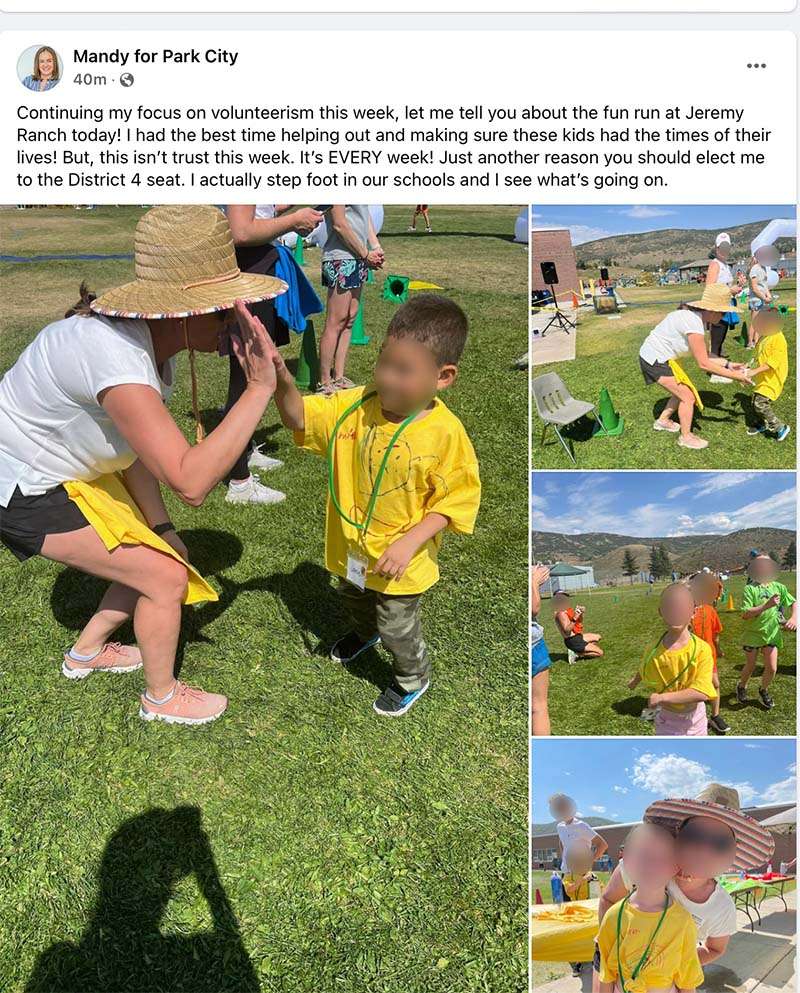
The main problem with that is that you can’t volunteer at a school and take pictures of children, according to a Park City School District video on volunteering. PCSD says this violates the Family Education Rights and Privacy Act — or FERPA. FERPA was designed to protect the rights of children in our educational environments. We know the school district considers pictures to be considered private information because their information video says, “School staff and volunteers are obligated to abide by the Federal Education Rights and Privacy Act, commonly known as FERPA — which restricts individuals from taking images.”
You may be thinking, “Josh, wow, you really have it out for Mandy. You are describing an obscure law. Everyone takes pictures of kids. What is the possible harm?” First, it’s not an obscure law, since the school district made a point to make a video about it. Second, Mandy is a school board member. So, she should know the details. As for “every one takes pictures of kids” that likely needs to stop based upon current laws.
Finally, what’s the possible harm? This is why I wrote this article. For some people, this isn’t a game. When I first started filming Summit County meetings a woman approached me and told me that I couldn’t film her or she would sue me. Being full of bravado, I told her that this was a public space and she had no expectation of privacy. She then explained the situation to me.
She was a victim of domestic violence. She and her children had escaped a relationship and the abuser had no idea where they were. By filming her, and posting it online, I could endanger her and her family. After hearing that, I never posted her face online. It was the human thing to do.
Laws like FERPA are in place for a reason. They are there to protect our most vulnerable. Did Ms. Pomeroy mean to harm someone? Of course not. I believe she was there to watch her kids run and then saw it as a campaign opportunity. Perhaps she received permission ahead of time from Jeremy Ranch to film. However, I doubt that’s the case.
Instead, it shows a lack of judgement. It shows a lack of understanding of current directives. Along the way, she may have endangered children and their families
We all have the opportunity to grow. Hopefully Ms. Pomeroy learns from this. I think what makes this worse than someone randomly taking a pic at a school is that it seems to be more of a political ad than a random picture. I’m not sure what violating a federal law or school policy means for a sitting board member. Probably nothing — given the current environment. I guess we’ll see.
Most importantly, I hope the picture hasn’t caused harm to anyone or their family members.
You have to be cruel to be kind about the Park City School District
Most of us who live in Park City love the Park City School District. We have great teachers. We have great administrators at our schools. We have great kids who attend those schools.
I am often asked why I am so hard on the school district. When I ran for school board, the head of Summit County’s Republican Party questioned my temperament because, to him, my criticism seemed over the top. That tells you something.
Yet, here’s the thing. I support our schools. I voted for the bond that is paying for 2/3 of our school improvements. I am a taxpayer who is likley paying for the other third that is supposed to be covered by lease revenue bonds. I have a kid in the school district. So I want — no, I NEED the school district to succeed.
And that’s it.
So, back to the question of why I am so hard on our schools. Three reasons.
- We are a small and wealthy school district. We have 7 schools. We have a lot of tax dollars. The Ed Foundation covers so many of our expenses through donations. Financially, we so many advantages. We have so much potential. We shouldn’t squander that.
- Trust. Many educators don’t trust the district. Many parents don’t trust the district. The district continually gives people reasons not to trust it.
Can Jeremy Ranch Elementary School really open safely tomorrow?
Most who ollow local stories are up to date on Summit County shutting down construction at Jeremy Ranch Elementary School (JRES) due to lack of permits. This left Jeremy Ranch Elementary in mid-construction. Apparently Summit County offered Park City School District a temporary permit that would have enabled the district to clean up some fo the mess and open safely. Allegedly this offer was ignoredby the school district.
So, now we are about 15 hours from school starting. Opening will be a complete mess at JRES. Dropping off children
If Jeremy Ranch Elementary doesn’t open on time, it’s the school district’s fault
There is a battle brewing between Summit County and the Park City School District. For those not following the blow by blow, the County has laws that require certain permits for building. The Park City School District (PCSD) didn’t get those permits before demolishing a part of the parking lot which edges up to the school. Summit County then shut down the school district’s construction at JRES.
Unfortunately, the demolition removed the bus dropoff and teacher parking. When the shutdown order occurred, it also left the school in an unsafe status. Often used emergency exits were caged in by a fence. Fire hydrants weren’t accessible from the parking lot. In order to ensure the first day of school, August 17th was safe, Summit County offered PCSD a temporary permit to fix these issues. However, apparently those overtures haven’t been accepted
How will the standoff at Jeremy Ranch Elementary School end?
The situation at Jeremy Ranch Elementary School (JRES) is only becoming more bizarre. Here is where I think we stand. The County has laws that require certain permits for building. The Park City School District (PCSD) didn’t get those permits before demolishing a part of the parking lot which edges up to the school. Summit County then shut down the school district’s construction at JRES.
Unfortunately, the demolition removed the bus dropoff and teacher parking. When the shutdown order occurred, it also left the school in an unsafe status. Often used emergency exits were caged in by a fence. Fire hydrants weren’t accessible from the parking lot. In order to ensure the first day of school, August 17th was safe, Summit County offered PCSD a temporary permit to fix these issues. While Summit County and PCSD discussed the temporary fixes, it appears PC
The Park City School District is dying because they are blind
It’s becoming clearer that the best days of the Park City School District (PCSD) are behind it.
Our success has been built on teachers’ backs, reputation, and the thought that money can buy success. Today, teachers are leaving, we’ve fallen to the 14th best PUBLIC high school in Utah (that’s not good), and tax increases are going to slow the funding of any future donations and tax increases.
Then we have the School District’s inability to get a building permit for their work at Jeremy Ranch. This is compounded by an arrogance where Summit County seems to be going out of their way to help the school district, but PCSD won’t even respond to the offers for help to get the building opened on time and in a safe manner. All the school district says is we will be open on August 17th.
Yet, if your kid goes to Jeremy Ranch, I would encourage you to drive by and look at what needs to be solved in the next 12 days. Are there safe fire exits for children in classrooms that have outside entries adjacent to the torn up parking lot area? Are exits handicap-enabled for those who have special needs? Are fire hydrants available to the fire department? Why is the playground still fenced off from children? When the playground is torn down, where will it be rebuilt? Where are the teachers going to park? Where are the buses going to drop off? Where are parents going to park? How will pickupwork? Most importantly, will the school district even talk about it?
That’s all short-term. And we, as parents, will feel it. Yet it is not the real issue.
The issue is the long-term effects of the way the school district is acting now. They don’t talk about anything of substance. They are in a constant state of confusion about how to act. Whether it’s masks, child rape, or building permits, they don’t seem to know what to do. Yet, they always think they are right; common sense argues with that. They are arrogant; most of us wonder why.
Yet, pride comes before the fall. Our children and teachers are going to pay for that.
Here is what is going to happen. If the school district doesn’t work with Summit County to resolve ALL issues in the next few days, Jeremy Ranch won’t open on time. If that happens, it will be the school district’s fault.
Then, the uproar over property taxes increases is only going to get bigger. My property tax increased by $1,500 this year. That’s really money. I’m further enraged at the Park City School District because they had previous bonds that were paid off, but they decided to continue to charge taxes for them this year because they can. As of next year, the public will be able to vote on any tax increases above the basic levy. Money is going to be harder to come by.
We are entering a period where the public is fed up with tax increases. If you are a teacher, any new agreement with the district for raises is going to be dependent on a tax increase. That won’t be easy and many teachers will want to leave. That said, I’ve never heard from a teacher who left the Park City School District in the last five years and regretted it.
PCSD’s last bastion of funding comes from the Park City Ed Foundation. Will that funding decrease due to the economy’s headwind and inflation? Likely.
This should be the time that the Park City School District is getting in front of issues. However, they are fighting a two-front war. They won’t talk to the major news source in town because KPCW does what NEWS is supposed to do, they report it, and Park City School District doesn’t like that.
Second, they are fighting Summit County over building. Trust me; PCSD is bringing a knife to a gunfight. Summit County Planning fights Vail in the morning and Alterra at lunch. That is further shown by Summit County’s maturity in offering to help the school district. Yet, that offer appears to have been ignored.
And that brings us back to the real problem. Almost everything we witness from the school district office is done wrong. These are the people who are supposed to educate our children.
The best days of the Park City School District are behind us.
What we are facing now is likely to be ugly.
It reminds me of a T.S. Eliot poem :
This is the way the world ends
This is the way the world ends
This is the way the world ends
Not with a bang but a whimper
The Park City School District is heading down hard, and I don’t think they even see it. They are blind.
I hope we find an equilibrium for our teachers and kids.
Property taxes, the Park City School District, and plain stupidity
I received my property tax notice from Summit County yesterday. It’s up $1,500 from last year. As they say, “that’s real money.”
Three things seem to influence that. One, my property’s “value” went up by $600K. Two, the Park City School District increased taxes. Three, the state increased its levy for schools.
I am fortunate enough to be able to pay the increased taxes, but many people are going to be hit hard. What adds insult to injury is a school board meeting I was at a month ago. The school board unanimously decided to keep tax rates artificially high. The district had paid off a bond but decided to keep taxing us for it just in case they needed the money.
While it upset me at the time, now I am furious. I am furious for me. I am furious for you.
The school district doesn’t appear to care.
Nor do they appear to care about the building problems at Jeremy Ranch. The school district hasn’t followed the proper planning process for construction at Jeremy Ranch. This has shut down construction. Today we learned that the County has been educating the school district about planning requirements for years. Yet, the County has been ignored. The Park City School District’s builder, Hughes Construction, apparently doesn’t believe it needs to abide by Summit County rules, according to Summit County councilmember Glenn Wright. Mr. Wright says, “They have a contractor who says ‘no I don’t have to do that.'”
I’ll provide a personal story. A few years ago, I needed to replace the deck on my house. The builder said I didn’t need a building permit, likely because it would be easier for them. I took it upon myself to call Summit County, and they told me I did. So, I went through the process. My deck was done better because of it. Oh, and it was also the legal process.
If Hughes Construction doesn’t want Summit County involved in their Jeremy Ranch Elementary School construction, you have to wonder why. If they are doing everything to code, it should be as simple as an inspection.
Then you have the Park City School District, who hasn’t commented on the issue to KPCW. Worse, Summit County offered an olive branch to the school district on August 1st with a Limited Scope agreement that would enable the school district to get ready for the upcoming year. This would allow the school to open on August 17th. As of Thursday afternoon, KPCW is reporting that the Park City Schol District has not responded to the offer.
I keep trying to find a way of describing the actions of the Park City Schol District as it relates to the broader community.
It’s time for the Park City School District Superintendent to move on
Jill Gildea. I met you when you first started. You had promise. Since then, we’ve given you a nice house to live in. We have given you a car to use. We’ve paid you over $400,000 a year.
In return, we just wanted good schools. We wanted lack-of-drama. We wanted honesty.
Wherever we are, it’s clear we didn’t get it.

Parkrag
We believe in citizen journalism. We believe there are stories to tell that can help to shape our community for the better. We believe tomorrow's Park City can be better than today's.