
We’re still not comfortable with the Jeremy Roundabout plans
Summit County is in damage control mode – yet again. This time it’s the Jeremy Ranch Pinebrook roundabout project, and as with Kilby, safety for pedestrians and cyclists is the issue.
We think the County’s response (and design requirements) say a lot about how they think about this kind of project, and demonstrate that they’re generally clueless when it comes to building a transportation system. In a Nextdoor post about this topic, Krachel Murdock (Summit County community affairs liaison), had this to say:
“We’ve heard your questions about pedestrian and bike improvements that will be included as part of the upcoming Jeremy Ranch Roundabouts project. This project will provide full north-south connectivity – allowing pedestrians and cyclists to travel from Quarry Village to Jeremy Ranch Elementary without ever using the roads! “
Sounds fantastic, right?
Here’s the problem – most of Pinebrook all of the lower area within bike/walk distance of JRES) is zoned for Parley’s Park elementary – not Jeremy Ranch. Pretty much every resident of Jeremy, on the other hand, sends their kids to JRES. So crossing under the highway between Quarry Village and JRES is an almost useless “accommodation” for 99% of us.
Maybe a few teachers from JRES would like to hit Billy Blanco’s for a burrito and a margarita at lunch, and would love to ride their bikes to get there. Awesome. But for the hundreds of kids that live within a mile or two of JRES in Jeremy, these are literally tunnels to nowhere.
Let’s say we take the county at their word that
1) The money just isn’t there to build more tunnels
and
2) This project has to happen NOW, we can’t possibly wait until more funding is available.
Even given those (dubious) priors, tunnel money would be better spent crossing Homestead (access to JRES for Jeremy kids, and access to Rasmussen Path/Kimball Junction for everyone in Jeremy) and Pinebrook Road (access to Ecker MS and Kimball Junction for residents of Summit Park and Timberline). Tunnels at those locations would actually improve the usability of the system as a whole for the people who want to use it.
Of course, crossing the on/off ramps without a tunnel would be terrifying (as it is now). We should have tunnels there too! But the north-south crossing is less used and less useful to the people living in the area than east-west, so if we’re doing transportation-system triage – that’s where we should be looking.
It’s clear that no one at the county uses the paths they fund and design because even the most casual of bike riders know that most of the bike traffic from Jeremy and Pinebrook is traveling east-west, not crossing under I-80.
As a reminder – we’ll be living with this project for the next 30 years. The County says they’ll “monitor” the situation and request more funding for pedestrian and bike amenities in the future – but we all know that once the concrete is poured and the utilities are in place, there’s little chance of significant improvements going forward.
Let’s do it right. On a nice spring day, we want 100+ bikes parked at the racks at JRES – as well as a smoothly flowing morning commute through the roundabouts.
There’s a mode of failure that doesn’t involve pedestrian injuries or fatalities – it’s when we make something that frightens pedestrians so much that they give up and drive instead. Clearly, that kind of failure is perfectly acceptable to the geniuses who brought you Kilby road.
Jeremy and Pinebrook roundabouts will be bad for bikes and kids
Summit County’s LetsGoSummit flyers and website are gorgeous. Soothing green and blue fonts explain how the new Jeremy Ranch and Pinebrook roundabouts will “improve mobility and safety and protect the environment while enhancing the economic vitality of Summit County.” There’s even a cute graphic at the top with a bus, a traffic signal, and a bicycle.
So it’s unfortunate that Summit County has decided to throw pedestrians and cyclists under the proverbial bus.
For years, Summit County has been working on getting people out of their cars and onto buses and bikes. The county spent millions on a park-and-ride by Ecker Hill and hundreds of thousands more on connecting it to the rest of the bus network. They launched an electric bike-share program in 2017 with the hope that residents will use rented bikes instead of their cars.
E-bikes have the potential to make those shorter commutes easy and fun. As prices drop and bikes continue to improve, the potential exists to get a LOT of people out of their cars. Riding an E-bike is an incredible experience. For a town with as many problems with traffic congestion as Park City, a fun and short commute via an E-bike is a dream come true.
That’s if they can ride safely, of course. For most people, that means minimal riding on surface streets with speed limits over 25mph. Once you’re out of your immediate neighborhood, you need to be away from the cars. Luckily we have a fantastic network of bike paths that we can use to get almost anywhere.
So when we examined the plans for the new roundabouts, we were shocked to see that instead of off-grade crossings to allow residents of Pinebrook and Jeremy Ranch to access the Rasmussen and Kilby paths, the county plans merely to install crosswalks. CROSSWALKS.
If you’re riding, walking, or otherwise commuting without a car, you’ll have to cross the roundabout at least once and often twice to access the trail – unless you want to roll the dice and ride in the road with the cars.
Even worse, kids walking, skateboarding, or biking to JRES or Ecker will have to negotiate the roundabouts on their way to school – during the busiest times of day.
How bad can that be? You might ask. Well, pretty bad, really.
Most of you are familiar with the roundabouts in Kimball Junction. Some of you may have even tried to cross them at busy times and struggled to get drivers to stop, or had to sprint or dart back to avoid being run over. If you’re like many of us, you’ve come close to hitting pedestrians even when you’re alert and paying attention.
The problem for pedestrians when entering a roundabout is that drivers entering often only to look to their left to see if they can merge. Drivers exiting have a clear shot and often don’t look left or right at all. Of course, a pedestrian has to cross both lanes (entering and exiting traffic) and contend with 2 sets of drivers who aren’t looking where they’re trying to cross from.
For cars, roundabouts are great. Traffic can flow faster, more safely, and we’ll hopefully reduce congestion during rush hour (anyone who has tried to turn left from the I80 exit ramps knows how bad it can get). There’s no question we need major improvements for vehicles.
However, building them without off-grade crossings (tunnels) will hamstring the bike/pedestrian path system – who cares how many miles of path there is, if we have to risk our lives to access it? Who on earth is going to send their kid off to school on their bike knowing our little ones will have to cross the roundabouts during the morning rush?
We contacted Krachel Murdock, the spokesperson for Summit County, and asked why the county chose to do this, and she said, “There are not underpasses of Pinebrook Blvd. or Homestead due to costs and physical constraints. It is anticipated there will be sufficient gaps in traffic to safely cross pedestrians.”
We then asked what the county planned to do if there weren’t sufficient gaps in traffic and she responded, “Plan B would be future underpasses of Pinebrook Blvd and Homestead. Surface crossings are used at many roundabouts where there is heavy traffic and pedestrian use, such as the roundabout at WalMart. The County monitors traffic conditions at our busiest intersections and proposes solutions when problems exist.”
There are 2 interesting things about this response: Most people wouldn’t send their kids to cross the Walmart roundabout for a million bucks. It’s terrifying! Does the county really think that is an example of a safe intersection for pedestrians and bikes, let alone one that will encourage biking and walking? Second, c
We followed up again by asking if the county anticipates that the pedestrian situation at the new roundabouts will be similar to that of the Walmart roundabout, but did not receive a response.
Let’s be clear – the roundabouts are needed. If the county is sincere in wanting more residents to commute without getting in their cars, though, they are failing miserably here.
If you build something that terrifies parents and bike riders, they will just drive to their destination and never attempt to cross the crosswalks. Traffic engineers will look at the traffic and say “well, there’s no problem – no near misses, no accidents, pedestrian safety is great.” But that will only be because no pedestrians are willing to risk the crossing. And the county will wonder why they can’t get people out of their cars.
The e-bike share program won’t help if we don’t have the physical infrastructure in place for people to safely ride anywhere.
The county is being pennywise and
If you ride your bike from Summit Park, Pinebrook, or Jeremy into Kimball Junction (or beyond), the roundabouts (as planned) will introduce danger into your routine. If you have children that go to Jeremy Ranch Elementary School, the danger is almost unfathomable. Or more succinctly put, kids won’t ride their bikes or walk to school for fear of trying to cross the six-way roundabout.
Unlike Kilby Road, citizens have a chance to make a difference at the Jeremy Roundabouts, because development has not started yet. If you have an opinion, please email your county council at
If you don’t care, please don’t complain about traffic in the future. These are the little (and important) steps that our community needs to take to address traffic. A million buses won’t solve our traffic issues. However, if we can design our pathways to be bike and human-friendly we have a chance to make things better.
The upcoming Jeremy and Pinebrook roundabouts are anything but human-friendly. Let’s hope we can come up with a better solution than crosswalks. If not, we will end up with a worse solution for pedestrians and bikers than we have now.

 in Schools
The REAL issue with standards-based grading at Park City schools
Last week Park City School District (PCSD) put on the full-media-blitzkrieg regarding standards-based grading. They called it, “The Facts About Standards-Based Learning.” They wrote a letter to the Park Record on the subject. They published that letter on their website. They even texted every parent in the district with a link to that same letter.
Here is a point-by-point paraphrasing of what they said:
SBG is good. SBG is good. We want to do SBG because SBG is good. Three years ago teachers at Ecker went to a conference, took some classes, did some research and determined that SBG is good. This year SBG was implemented at Ecker. The grading scale is 1-4, with a 3 meaning your kid is proficient at something. Teachers drove this Ecker thing, but now every school wants to use it, so the District Administration has gotten involved. SBG will be at every school in PC by 2022. Because of that, the District is only beginning to educate parents on why SBG is good.
Right now more than half of Treasure teachers use SBG and by 2020 they all will. Some teachers at the high school also use SBG. The District will convert 1-4’s to A-Fs for secondary students and transcripts will look the same. Elementary schools may use SBG at some point.
SBG is good. SBG is good. Parents, talk to your teachers or Principals if you have questions.
After spending over 50 hours on this topic, I have concluded that the School District still doesn’t quite get it. I’d say 95% of the people I have spoken with about SBG say it SOUNDS great. People love the idea of it. However, when you look at the district’s communication blitzkrieg, the predominant message is “SBG is good.” Yes, we get that. Unfortunately, they completely miss the point.
THE PROBLEM HAS BEEN IMPLEMENTATION.
Not since the 2015 bond, have I received so many emails and calls from parents concerned with the school district. The calls aren’t wanting to discuss the merits of SBG. The calls are about the implementation. They want the school district to explain how this new paradigm works, in detail.
Parents want to know how SBG works. They want to know specifics on how it will impact their kids in the future as they progress through grades into college. They want to know why they are seeing inconsistencies in how teachers implement “standards” based grading. They want to know why some teachers are teaching to mediocrity. They want to know why parent FAQs said there would be no conversion to traditional grades, but now the district says they will convert to traditional grades. They want to know why teachers complained about poor (or non-existent) training. They want to know why a random teacher said something about SBG to their child that made absolutely no sense to the kid. They want to know why some teachers have changed childrens’ grades after the facts because “someone told the teacher they couldn’t give a 4.”
While maybe it sounds like a communication problem, it’s not. It’s an execution problem. That’s what PCSD needs to understand. While parents and children are asking questions, they are asking questions because the implementation has been problematic. The details haven’t been figured out. The process isn’t consistent. Teachers haven’t received adequate training. Those things manifest themselves as a communications issue but have a deeper root cause.
Solving that is much harder than making a press release and holding community meetings. The Park City community has been jaded by government meetings designed to push an agenda. People show up to school bond hearings, Mountain Accord meetings, truth in taxation meetings, random development meetings, and many other meetings about issues and find their opinions make little difference. Many times, their concerns are dismissed. It’s not hard to see why people don’ show up.
So, the school district shouldn’t discount the anger just because people don’t show up to meetings that the district has designed. People are showing their fury in other places.
The constructive question is where do we go from here? It’s pretty clear the district isn’t reversing course on SBG — and they probably shouldn’t because the SBG CONCEPT seems to have broad support. So, how do they fix the implementation at Ecker? They probably can’t fix it this year or maybe even next year. SBG is not only a complete shift for students, but it’s also a complete shift for teachers. Ecker needs to find a way to instill consistency across all teachers at the school. Before that can happen, all teachers and administrators need similar training, so they share a common understanding. Then computer systems need to be in place that entirely work with SBG. Along the way, decisions need to be made about appropriate goals for students and the standards that are going to be taught.
If we view standards-based grading as beneficial because EVERYTHING IS STANDARDIZED, then the people who implement this have to all be using the identical playbook. It will take a while to get there. It’s a work in progress.
If you have a kid at Ecker and are concerned over this issue, I wish there was a better answer. However, perhaps it’s one of those real teaching moments for your kid. This experience could teach them that, “humans are fallible. Your teachers have bosses who make them do things. Not everything is perfect. Doing something is harder than talking about it. This is middle school, and in the end, it probably won’t matter much (so don’t let it get to you). Use this an opportunity to try and learn and not worry so much about grades. Your school did something unfair to you, but you have no choice other than to make the best of it. This won’t be the last time you’ll be treated unfairly. You’re going to get a great education in Park City, regardless of this. C’est la vie.”
I also understand that the above is easy for me to say. I don’t have kids going through it.
That said, if you have kids at Ecker, you have a chance to make things better for the next generation of kids (and your kids once they hit TMJH and PCHS because eventually, SBG will be everywhere ). So, please do what that school district directed in their “The Facts About Standards-Based Learning.” Ask every question you can think of to your school’s Principal and your child’s teacher. In a transition like this, no question is a dumb question.
If I had a kid in Ecker, here are the things I’ ask:
- I’d ask for a list of the standards that will be taught that year in each class. Utah has so many standards for each grade/class, it is impossible to teach them all. So, it’s fair to know what standards a teacher will be teaching to during a year.
- I’d want to know what constitutes proficiency in each standard (what does your kid need to do to get a 3)?
- I’d want to an example of going beyond proficiency (i.e., what it takes to get a 4) for each standard.
- I’d want to know how going forward, for each time my child was receiving a standards-based grade, what was the maximum grade possible (Was it a 4? Was it a 3?). That way I can talk with my child about his or her performance.
- For any arts-based class, I’d want to make sure I understood exactly how proficiency would be addressed. It’s a little different with orchestra, band, etc.
- If there are conversions from SBG to grades and a GPA, what is the conversion scale? Is the
scale standard across the school?
Maybe these aren’t your type of questions; perhaps you have others. Great. But please ask the questions you have. Your child is owed that. It’s also fair. If the school district is trying to move to a system that tells your kid if they are proficient, your child has the right to know ahead of time what proficient means.
I know you are probably thinking, ”My kid’s teacher doesn’t have time for answering all these questions. They don’t have time to do what they do now.” True. However, they are your interface to the Park City School District organization. Put another way, sometimes the keyboard on your new MacBook doesn’t work right. You have to talk to the Genius at the Apple store to try and fix it. The Genius may tell you there is nothing they can do to fix it. But when 10,000 other customers come in and ask the same question, Apple eventually will understand they have a design flaw.
By applying pressure where you can, you can affect change in the long-run. Unfortunately, massive changes won’t happen today, tomorrow, or even this year. With work, however, SBG at Ecker will be better next year. Most importantly, for parents with children at Ecker, if you apply the pressure now, the district will likely have a better process in place for when your kids hit 9th grade at TMJH — when it really matters.
The school district seems to be focused on trying to convince the Park City Community that SBG is a good thing. That’s probably because the real issue is a much harder nut to crack. How do you replace a 100-year-old A-F grading system with something new? How do you get hundreds of teachers and thousands of kids on the same page? How do you do that and keep the high standards people have come to expect?
That’s the hard part.
The even scarier part is the district has little time to get this right, ensure they don’t impact students’ desire to learn and education along-the-way, and find an answer to why studies show SBG ACT scores are a couple of points lower than traditional grading.
If Park City’s standardized test scores drop, that’s when the Parents with Pitchforks really come out. No one wants to see that.
God speed PCSD. You have a long way to go and a short to get there.
Do you ever lose faith in the people of Park City?
Reading the Park Record Police Blotter this week, the top entry was about four calls to the Police department about potholes. What?
Who would call the police about potholes? My god.
Maybe they just weren’t getting the response they hoped for from Public Works. Maybe they personally brought this up to City Manager, Diane Foster, and got no response. Then the only recourse they felt they had was to call Andy Griffith, I mean Wade Carpenter, and report the issue.
Come’on people. You make us look less than intelligent. That’s putting it mildly.
I know, I am going to get the hate mail saying, “By God, you just didn’t see the size of that pothole. It could swallow a whole child! Why do you hate children?”
Nevertheless, the phone number for Park City Municipal Streets and Lights is (435) 615-5306. If you are past the White Barn and you see a pothole call Summit County Public Works at (435) 336-3970. If you are on a trail and see a pothole, call Basin Rec at (435) 649-1564.
Just please don’t call the police or sheriff. Someday you, me, your friends, or your family will wish they weren’t investigating potholes.
in Schools
An update on Standards-based Grading at Park City Schools
On Wednesday, the Park City School District School Board met and discussed Standards-based grading (SBG) with Traci Evans, Interim Associate Superintendent of Teaching and Learning.
After watching the hour-long session, I have a much clearer understanding of where we are with the new method of learning being implemented at Ecker Hill, Treasure Mountain, and soon other schools. Your view of the program will likely depend on your expectations.
If your view is that SBG is a process where students, parents, teachers, administrators, and board members are developing the plan as we go along, then you are probably OK with the district’s implementation. You may conclude that in any complex transition, you’re not going to know everything up front. Therefore, you have to adjust to changing conditions on the ground. Or as Mike Tyson said, “everyone has a plan until they get punched in the face.”
The opposing view is that the school district is changing one of the critical tenets of how education works — one that has been in place for a hundred years. You may conclude that in a change this large and complex, a detailed plan would be in place ahead of time that addresses every detail of the transition. Or as Benjamin Franklin said, “If you fail to plan, you plan to fail.”
I agree more with the latter viewpoint. I believe the fundamental issue with SBG right now is that initial planning wasn’t detailed enough. Due to lack of planning, implementation has been difficult. Poor execution has then led to confusion across parents, children, and teachers. Now, the school district is scrambling.
I believe this assessment is supported by the school board member comments in Wednesday’s meeting about parental confusion with the process. It’s also supported by Ms. Evans, who at one point in Wednesday’s meeting said they might not even ultimately stick with SBG’s 1-4 grading scores. It is also supported by a school board member who asked the question, “but is the goal that the district is migrating to this [SBG]?” If School Board members don’t know the extent of plans regarding SBG, it clearly indicts the planning process. By the way, the school board member never received an answer in the meeting.
I believe this view is also supported by teachers rewriting student goals mid-year to be more in line with SBG, by a parent FAQ on SBG being published two months into the school year, and by the haphazard training of teachers.
Ultimately, my critique of Park City’s SBG implementation isn’t meant to point fingers or assess blame. Wednesday’s meeting showed that the School Board, Superintendent Gildea, and Ms. Evans have nothing but our childrens’ best interests in mind. I think many of our school administrators believe SBG is the right path forward. I have to admit judging our children on what they know, based on a set of standards, sounds good. The question is how you get from a hundred-year-old system to the new world order.
It seems the school district’s answer to this is communication. If only the public would show up to meetings, and if only they would listen, and if they just knew what we knew, then they would understand. The problem is that those trying to communicate to us are true believers in a land of skeptics. No amount of talking at us, saying the same thing over and over, is going to convince us.
I believe they still need what they didn’t have in the first place — a PLAN. Give parents, students, and teachers a 200-page plan that is comprehensive and understandable for the sixth-grader on up. Then, make sure it details every aspect of SBG for Park City schools. Tell us why the district is doing it and when. Give us all the rules. Go into detail and tell us whether SBG’s 1-4 scale will be converted into A-F and how it will be converted into GPA. Tell us specifically what standards will be graded for each grade-level. Give us examples of what represents a 1, 2, 3, and a 4 in common subjects. Provide us mandates that should be observed by teachers, such as when a student can retake tests and whether all assessments should provide 1-4 grading (i.e., in SBG sometimes a test only has a maximum of 2 if the subject matter being tested isn’t designed to test complete proficiency). Answer every question you can think a student, parent, or teacher may have. Document the training plan to get all teachers up to speed. Then demonstrate how teachers will be evaluated based on the new structure, which will likely require working with the Park City Education Association to make sure they are on board. There are likely dozens of other components which would make up a comprehensive plan. I’m not talking fluff, PowerPoint highlights, or presentations designed to convince people that SBG is good. I’m talking about a plan that shows thoughtfulness, foresight, and is in excruciating detail.
The Park City School District needs to provide a document that shows that the district has all its ducks in a row. It should be the hymnal that administrators, teachers, and students sing from. If something is not in the PLAN, then it doesn’t exist.
Yes, it’s an incredible amount of work. However, it should have been work that was all completed before the SBG process ever impacted one child. This is a big shift. We’re not talking about what color a hallway should be painted, or even what the design of a new Treasure Mountain school should look like. This is more fundamental. We are talking about how every child will be educated in the school district for decades to come.
If this is a transition we really want to attempt, then we’ll likely need to spend tens of thousands of dollars on getting help from experts in order to produce a detailed plan. That’s OK. If we really believe in it, and we want to change the fundamental direction of our schools, then that is money well spent.
I’m not sure what that means for the kids and teachers at the test-tube known as Ecker Hill. Perhaps teachers can decide independently if they want to continue SBG. Then the 1-4 grades some teachers want to use can be converted by our school district’s software into A-F. That would give us time to fully plan out a transition.
As I take a step back, I’m convinced that we didn’t fully plan our move to SBG. That said, I’m still not fully-convinced that SBG is the right direction. As I pointed out in a previous article, students in SBG have been shown to receive lower ACT scores.
Likewise, here is an article from a junior at a high school in Kentucky, talking about why she thinks SBG can be detrimental. As you start to research SBG, it’s not all that clear-cut. What seems like a great idea at 30,000 feet is often less clear once you get in closer.
However, as I’ve said before, I’m not an educator. At some
My hope is that if we take a step back and intricately detail how we would roll out SBG, it may give our educators a chance to step up and use their experience to tell us whether we are going in the right direction. If we are, then they can provide ideas on how to get it right.
Note: If you’d like to watch the video of the meeting and form your own opinions, you can watch it at the link below. You want to click on the link and then click on the Assesment Task Force link on the right side. While I’m grateful that they provide video at all (most other government
https://video.pcschools.us/videos/video/9787/
in Schools
The Park City School District’s grand experiment continues
Do you remember your high school grade point average? How about your college GPA? The concept of a GPA and an F to A grading-scale is what most of us grew up with and has been around over 70 years. There is even a saying about that, “A students work for the B students at companies founded by C students.”
If you’ve always felt that the traditional grading of F to A isn’t quite right, then I’ve got good news for you. You can start to forget everything you knew about the archaic method of schools judging your child. The F through A grading-scale isn’t quite dead, but the Park City School District (PCSD) is showing it the door. In its place is a new-fangled grading system. Let me introduce you to 1-4 grading. The fancy name is standards-based grading (SBG) or sometimes called standards-referenced grading (SRG). And it’s coming to a school near you.
Instead of your child receiving an F, D, C, B, or A in a subject, they will now receive a 1, 2, 3, or 4. Generally speaking, a grade of ONE, according to Park City Schools, means “the student requires assistance.” TWO means, “The student has many of the prerequisite skills but has not yet achieved mastery on the Utah State Core Standard.” THREE means “The student has completely mastered the Utah State Core Standard.” FOUR means, “The student has gone above and beyond grade level expectations and has applied extended thinking and application of the standard in novel situations.” Specific 1-4 goals are also written for each and every project, assignment, and assessment to adhere to the state’s core standards.
The goal of SBG is to assess whether students have competency in a subject. Standards will drive our children’s education. Effort, discipline, and homework don’t impact scores (those are included in a citizenship/behavior score that doesn’t affect 1-4 grades). Children are graded on whether they are proficient in a concept. Currently, Ecker Hill uses SBG throughout the school. Treasure Mountain implements it in many classes. By 2022, Park City School District (PCSD) hopes to implement it throughout the system.
You may be thinking that SBG sounds like a good idea. I think most people probably do because it looks great in concept. That’s where the Park City School District’s grand experiment begins. This year, PCSD introduced SBG to Ecker Hill Middle School. From most accounts, teachers were not adequately trained. Parents were not adequately informed. Students didn’t know what was going on. If you’d like detail, here is a survey completed by over 40% of PCSD teachers that support those assertions. I have also read hundreds of comments from social media about parents not able to explain the process to their children. I’ve talked to kids who don’t understand the grading process — at all.
You see, SBG is confusing. As a reminder, a score of 3 means proficient in a subject and 4 means that a student has demonstrated a level of understanding beyond proficiency in a subject. So, is a 3 an old-world A or is a 4 an old-world A? The school district would likely tell you to stop trying to equate the new with the old. They would say the new world order is that we are NOW judging mastery — and previously we weren’t. So, what were the importance of grades before? Forget that. After a hundred years of A’s meaning proficiency, it is a tough task to retrain teachers, parents, and kids to understand that 3 out of 4 ain’t bad.
To complicate it more, teachers can now give tests that don’t test total proficiency. So, a teacher may decide that the maximum “grade” on a given test is 2. Then your kid comes home with a 2, despite the fact they knew everything on the test — because the test wasn’t designed to test proficiency. The child and parents don’t understand why their kid received a ‘C’ or ‘D’ on the test. In the old world, it would like saying the best you can get on a test is a C. The nuance is tough. Unfortunately, in some ways, the subtlety can be soul-sucking for kids.
Even worse, teacher training for SBG seems to have been haphazard. Teacher training appears to have been a combination of some people attending a course on SBG, others being trained by those teachers who participated in the training, some teachers received some Skype-based training, and others were told to read a book.
When you are turning teachers’, parents’, and kids’ worlds upside down, like when implementing SBG, it can’t be this way. It has to be implemented impeccably. The people who are charged with delivering SBG must be experts. Those people are the teachers, and it’s evident in many cases they weren’t provided with the tools necessary to implement the vision.
I’ve heard talk that teachers at Ecker Hill will soon be rewriting all their SBG goals in more student-friendly language. If true, six months into the school year seems a little late to ensure that students can understand the goals they are graded on.
All that said, like a freight train, standards-based grading is likely coming to all Park City schools. Multiple committees are working on it within the district, and it’s likely to expand to elementary schools and the high school.
In elementary school, it will be interesting to see how SBG will interact with dual immersion programs. Research shows that dual language immersion (DLI) children are often behind in some subjects in the first few years. Then in later years, they are often ahead of their non-immersion counterparts. H
Then comes issues with high schools. Typically high school grades are of prime importance to college applications and scholarships. If you read about college admissions relating to standards-based grading, you will often read that admissions officers are always looking for the best candidates, regardless of whether they are in a system using traditional grading or standards-based grading. Yet, when you dig deeper, a couple of factors stand out. First, the job of admissions is to compare students. To do that, an admissions officer often needs a conversion-rate from 1-4 grading to a GPA. Take this example from Vancouver i-Tech Preparatory, which is often cited as an example of how to convert to SBG grades when needed. Yet, in the Park City School District FAQ on SBG, they state, “Question: Is a 4 similar to an A? Answer: No. It might make sense to convert the levels of proficiency to the traditional grading system but we avoid doing this because we are no longer averaging learning. In standards-based learning, we describe what a student has learned and to what level.” So, is Park City not going to convert SBG scores to GPAs for colleges? How will this work out? Will the district figure this out? Eventually, they may, but it shows the level of detail and thought needed. Much of this should have been figured out before the entire process started.
As important, standards-based grading may also impact ACT scores negatively. This should be important
It’s important to note that Matt Townsley, the author cited above, isn’t militant against SBG. He states that “Traditional grading practices have been used for over one hundred years, and to date, there have been no meaningful research reports to support it.” Likewise, Townsley has also cited studies showing higher academic achievement with SBG.
That said, why were students ACT scores lower when they were in an SBG environment?
Mr. Townsley and Mr. Vargas could not provide a definitive reason for the lower scores. However, they speculated that differences could be based on students “playing the game” with teachers when it came to traditional grading. This then led to a better ability to complete standardized testing. The authors suggest that educators implementing SBG should try to learn as much as they can from other studies and anecdotes in the scientific literature. It’s truly the wild west right now with SBG.
The other long-term issue with SBG is its impact on our teachers. By most accounts, many teachers at Ecker have been left blindsided by this effort. That leads to inconsistent implementation. However, we may not have seen the worst of it. One of the major tenets of SBG is that a child can take a test as many times as necessary to show proficiency. Will Park City mandate that practice? If so, how does a teacher work in that environment? If any parents are going to push their kids to take a test three times to show proficiency, it will be in Park City. How much teacher time will that require? My guess is a lot.
So, is SBG right for Park City? Truthfully, I don’t know that I’m qualified to provide an answer. The age-old joke is that everyone thinks they are an expert in education because everyone attended a school once in their life. What I do know is that Park City’s implementation was bungled.
What seems likely is that the district will need to figure this out within two years. That is when Ecker kids, who are currently under 1-4 grading, will enter high school. At that point, it’s time to sh*t or get off the pot. Once kids hit high school, they need to understand what game they are playing.
One way to look at it is the school district has two years to get it right and they probably will. The other way to look at it is that the district’s actions have negatively impacted kids who will be entering high school soon — and they can’t get that time back.
Ultimately, I hope that we take a step back. Is SBG something we want? If so, how and where do we implement it? Many districts start in K-6. Do we even want it in high school? What’s best for Park City?
More importantly, have we as a community even had those discussions yet?
Studies show SBG provides for higher levels of academic achievement. So, SBG is not a crazy idea. However, studies also show that lower ACT scores may accompany those results. Most importantly, it’s hard to see how academic achievement can be increased if teachers aren’t provided the tools to implement it consistently and accurately in a way that both students and parents understand.
Ultimately, there should have been no rush to implement SBG last fall. Traditional grading has existed for 70 years, and we weren’t going to win any awards for rushing into a new paradigm.
Yet, it seems like we have got ourselves into a bit of a quagmire. Hundreds of children (those at Ecker) are now impacted by a rushed program that wasn’t well thought out. Does the school district double down and continue to push this and impact thousands of students? Do they think a couple of committees can solve the issues in time for the 2019-2020 school year?
Perhaps the better option is to take a deep-breath and
If the district doesn’t reassess this process, they are looking at a far worse outcome than the failed 2015 bond election. People may begin to
That would be a far cry
in Vail
Snowbasin is on Epic Pass Next Year
Good news. Your Epic Pass will provide access to Snowbasin next year. Maybe that will reduce pressure on PCMR/Canyons… but I doubt it. It likely adds some folks north of Salt Lake who will pack parking lots in Park City more than ever.
It looks like 7 days at Snowbasin for Epic Pass holders and 2 days for Epic Locals. Then pass holders get 50% off after their days have been exhausted.
The question I always have is how much more is the Epic Pass going to cost next year.
For more info, here is the press release:
https://seekingalpha.com/pr/17403891-sun-valley-snowbasin-join-epic-pass
in Buses
Google Maps update makes riding Park City buses much easier
Understanding which Park City bus to take can be confusing. For those who ride the same bus every day, it probably seems simple. However, for those of us taking different routes, once or twice a week, it can be hard.
What do the bus colors mean? What is inbound versus outbound? How do I know when the next bus will come? What if I miss it? How will I get back from wherever I’m going. It’s
For the last couple of years, the best tool to navigate the buses was an app called My Stop Mobile (recommended by Park City and Summit County). It would show you routes, buses, and stops. It probably took me six months to figure out how to use the app effectively. Unfortunately, recently the app seems to be providing shoddy results. Often it won’t tell you when the next bus is coming. It won’t show you where buses are anymore. It will tell you no bus is scheduled today for the bus stop you are waiting at. It is confusing.
On Sunday morning, while trying to get back from Deer Valley, I gave up on My Stop Mobile and tried Google Maps and it was brilliant. It showed me the bus stop closest to me. It then showed me all the colors of buses and in how many minutes the bus would arrive. If I wanted to know where the bus was going, I could click on the bus and it showed all the stops. It was easy.
If you’ve had trouble navigating the bus or haven’t ridden because you’re not sure how it works, I’d give Google Maps a try. You’ll want to make sure you have installed the newest version of the app. After launching the app, click on transit at the bottom of the app.
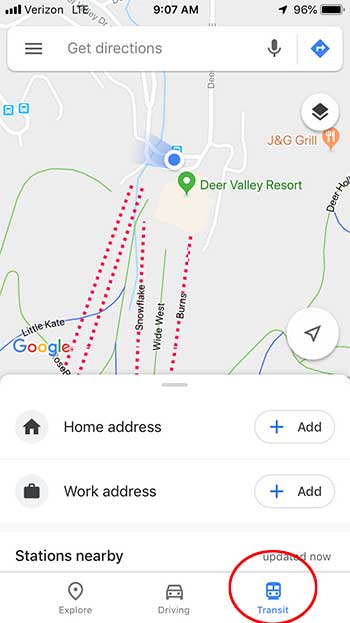
Then you’ll want to scroll down and show the Stations Nearby (It’s at the bottom of the screen). You should see the closest stations.
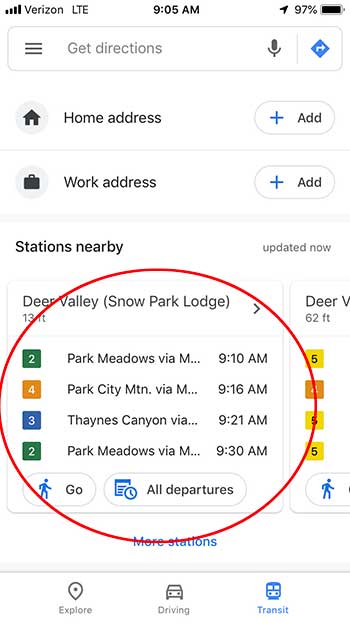
Google will tell you about the next buses that will arrive at your location. That’s great information. You’ll then need to figure out which one of the buses you want to take. Do you want the Green 2 or the Orange 4, or perhaps other departures. When you click on that item it will show you all the stops. It will look something like this:
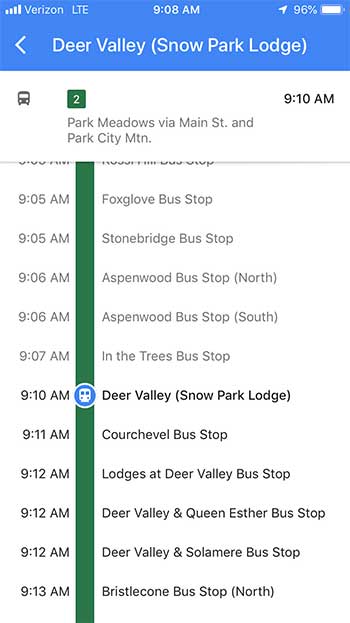
It’s not perfect, because you still need to translate what the “official stop” names mean, but it’s generally easy to deduce where a stop is located. So, it becomes much easier to figure out when the bus will come and which to ride.
Google has made it much easier to use Park City Transit. Currently, I believe it is the preferred method of using the service. If you give it a try, let me know how it works for you. Likewise, if you have any questions, let me know. I’m happy to help.
The newest issue with Kilby Road
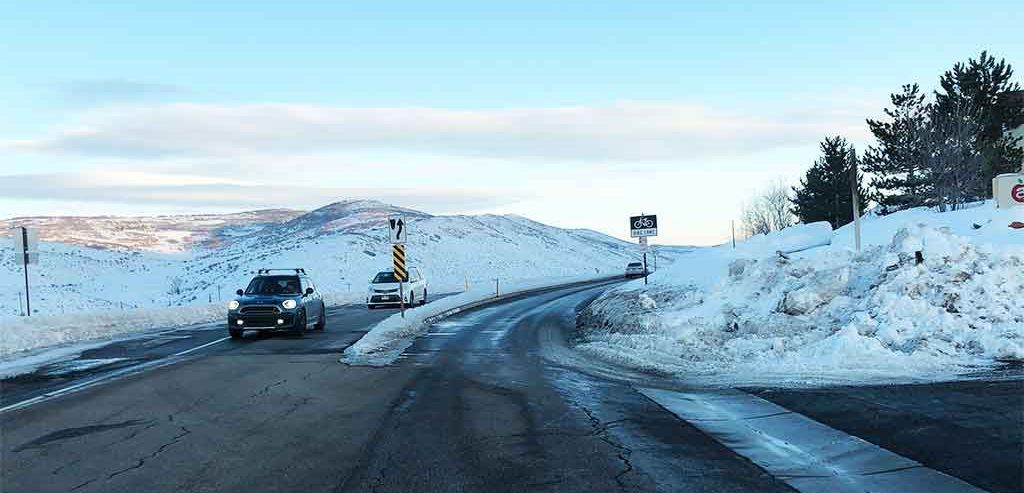
Just when you thought it was safe to back in the water… new Kilby Road issues have surfaced.
Since its inception, Kilby Road has been a problem. Kilby Road is the road that runs from Fresh Market, at the base of Pinebrook, to Walmart. The curves that were created to slow traffic cause traffic to go into the bike lane. That’s dangerous, and make people car sick, but it’s not a problem in winter because people just drive through the bike lane and thank god there are no bikes.
However, a new issue has arisen. On Friday I was driving on Kilby headed west back towards Fresh Market and a car was in my lane and headed right at me. I stopped when I saw the car headed at me — and I assume my honking and flashing of lights caused the car to stop and back up.
While this was the first time I have been involved in an incident, I have seen two other cars turn right out of Fresh Market and go onto the wrong side of the divided road. This used to not be a problem, as there
Now, for whatever reason, people are going down the wrong lane and they can’t get back to the correct side. I’m not sure why people are choosing the wrong side of the median. It makes sense to me but I have done it a million times.
Regardless, Summit County needs to get this figured out before something bad happens.
in Sundance
We’ll miss you Robert Redford
Each year I tune into Sundance’s opening press conference. I love the Q&A with Robert Redford. He tells it like it is.
This year Mr. Redford opened the festival by saying “This press conference has been going on for 34 years. Having done this for 34 years now, I think we are at a point where I can move on to a different place. I don’t think the festival needs a whole lot of introduction anymore, it runs on its own course.”
He then thanked the volunteers and left the stage — likely not to return.
Instead of the interesting question and answer that typically followed Redford’s remarks, where Mr. Redford would expand upon a plethora of topics from the state of the industry, to VR, to the history of Sundance, we were left with six “Sundancers” who expounded on fluff and self-indulgence. When they started comparing themselves to the Avengers you know this thing ain’t what it used to be. It felt like a bad Bravo show airing at midnight. Where’s Andy Cohen when you need him?
Who knows why it’s ending this way. Perhaps the festival has outgrown Mr. Redford and it’s no longer what he envisioned. Perhaps he does want to get back to the art. Perhaps he is turning it over to the next generation. Perhaps he is tired and has given what he can (thank you
Regardless of the reason, without Robert Redford’s face and influence, the festival won’t be the same. It was inevitable that the day would come, but it seems too soon.
Redford was Sundance’s soul. It was named after the most famous part he played. How do you replace that? I’m not sure, but Sundance better
Sundance has been about authenticity. Some of that is now missing.

Parkrag
We believe in citizen journalism. We believe there are stories to tell that can help to shape our community for the better. We believe tomorrow's Park City can be better than today's.