
 in Virus
Parkites should plan on four weeks off of school for Corona Virus
Today the state of Utah mandated that schools are closed for two weeks. The problem in Park City is that there are three weeks until Spring Break. A rational person would not take two weeks off of school, come back for one, and then go on break.
My hope is schools are back in session April 13, but I’m not counting on it. Objects in motion stay in motion and objects that aren’t …don’t.
See you in September.
in Virus
Good job Park City Municipal on Covid-19
Looks like Park City Municipal is doing the right thing with the Corona Virus. For the next 60 days, Park City will provide a bonus amount to employees who are not eligible for paid leave. They say this will include people sick, people caring for elderly relatives, or people caring for kids.
We have not heard what this bonus amount will be — and it is likely in flux. However, the city seems to be trying to find a way to help employees.
Vail Fails on Covid Response
Earlier I wrote about Deer Valley’s 100% refund policy on trips with 24 hours notice due to the Corona Virus pandemic. That’s being human. Wouldn’t you expect the biggest ski operator in the world to do the same thing?
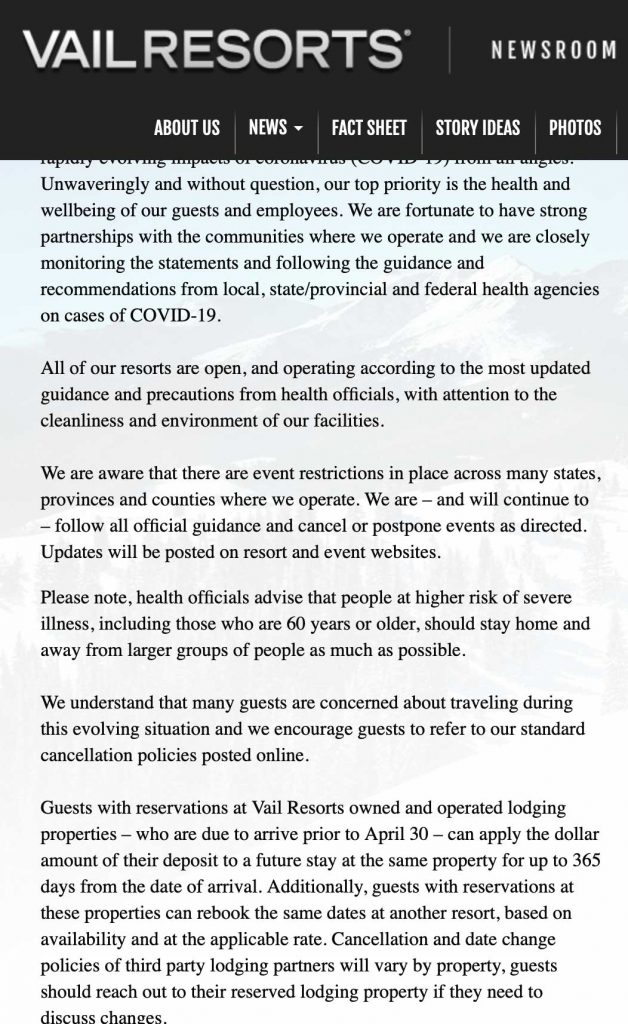
Nope. Vail announced that you can cancel trips but they won’t refund your money. Instead, they will apply money spent to a future travel date within the next year. That’s bullshit.
Yeah, you may not want to come to Park City because we have had cases of Covid-19 here. However, there are other reasons related to Covid-19 could be impacting visitors. Your business may have been impacted. Your hours could be down. Your stock portfolio may have dropped 20%. You may no longer be able to afford it.
I get that Vail is a business. They can’t be stupid. However, they can be compassionate. They should be doing what Deer Valley is doing. 100% refunds — no questions asked.
This soon will pass. Yes, earnings will be down, but they are going to be anyway. Be good to the people who want to come ski at our resorts. That’s being a part of the community.
 in Resorts
Deer Valley is doing the right thing with Covid-19
I give Deer Valley a lot of crap these days. It’s not the same place as it used to be thanks to the Ikon Pass and Alterra. However, Ski School is still second to none. The chili is still good. The grooming is still great.
Yet, I always wonder about the management. Bob Wheaton is gone and a guy most recently from Austin manages the place. It has given me pause.
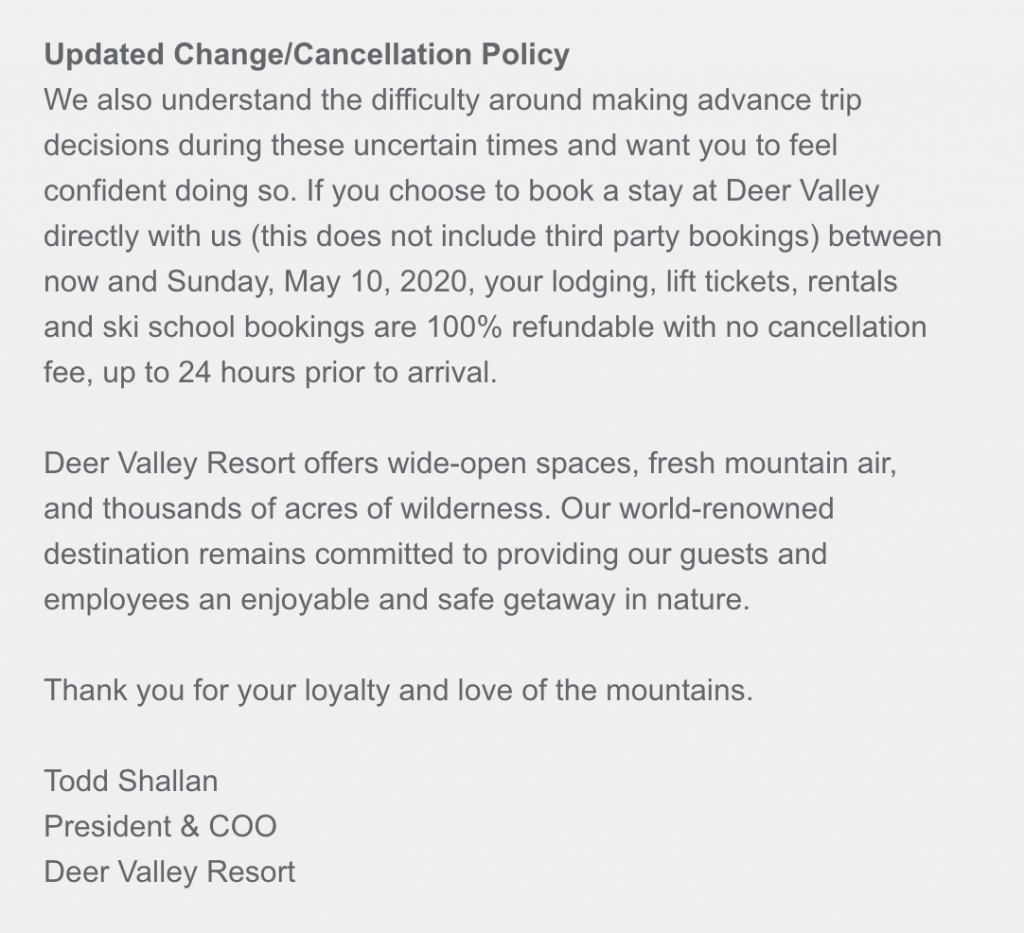
So, I was pleasantly surprised that Deer Valley’s COO Todd Shallan announced that lodging, lift tickets, and rentals are 100% refundable with 24 hours notice.
If you are reading this, you are likely a local and it doesn’t impact you. However, it should give us all a little faith that DV still gets it.
Good on you Deer Valley. It’s not all about money.
 in Skiing
Park City resorts may be closing soon
I apologize for three stories in a row on THE Virus. Yet, that’s where we are. As bad as it seems, it gets worse. Disney World is closing due to the Corona Virus. You know if Disney is shuttering their colossus in Florida (and in Paris), it isn’t good.
Here in Park City, the snow sucks. People aren’t boarding airliners. The non-existent skiers are not paying $15 for a hamburger. If you don’t think our superiors in Bloomfield are thinking about shuttering the season, I don’t think you are giving them enough credit. They are good at what they do.
I have no inside information, but you may expect Vail to close it down soon “out of an abundance of caution.” In the old days, Deer Valley would soldier through. Will Alterra?
Ski ’em if you got em. But whatever you do, be careful re-upping that Deer Valley Local’s pass, because it no longer rolls over.
Strange times, indeed.
Summit County’s response to 2nd Covid-19 patient leaves us in the dark
FYI, a second person in Summit County, under 60, has Covid-19. If by some luck of nature the Summit County Health Department knows you were at the same place as him/her you will be notified … Sure.
Frankly, this is crap.
Instead, they should be listing times and places where the individual ventured. Were you at Smith’s 30 minutes after this individual was there?
Do you have a fever? No. Great!
Do you have a fever? Yes. Get tested for Covid-19 immediately. Limit the spread.
It’s as if our Health Department went to Google and searched, “How do you handle a Pandemic?”. The problem is that it does us, residents, a disservice. I get it. The Health Department doesn’t want to create panic, hurt local businesses, or cause alarm. Yet, this is the sort of action that will lead to larger consequences.
Don’t get me wrong. I think Rich Bullough, who heads the department is good at his job. I have met many employees there and they are caring, wonderful people. Yet, how they handle this mess will define a career.
My view is that residents need all the information we can get. We need it detailed. If I feel sick, have a fever, and have been at a location at a time when a Covid-19 carrier has been there, it will influence me to be tested — which is the right outcome.
Instead, if the Health Department tells me that someone under 60, somewhere in Summit County has the virus, and they have been lots of places, but they can’t tell me where or when it doesn’t do me or anyone else any good.
I don’t need personally identifiable information, I just need to know whether I likely soaked up their germs at the Fresh Market. Then I can self-isolate.
The Health Department can’t do it on their own. They need your help. They need my help.
Help me… help you.
in We Love You
Corona Virus in Park City is a big deal for many reasons
There’s a divide in Park City. Is the Coronavirus (Covid-19) a big deal?
I was in line for some bacon at Deer Valley on Sunday and my seven-year-old asked if the Coronavirus was in Utah. A woman ahead in line interrupted and promptly told him that “he needed to stop watching the news” and that it was “no worse than the cold. “
On the other hand, a trip to Costco will show you people, clad in N-95 masks, pushing carts filled with 50 gallons of bottled water.
So which is it, a hoax portrayed by media outlets to garner better ratings or one of the four horsemen of the apocalypse? In the end, will this be an unfortunate blip on the radar or Spanish Flu part 2?
No one knows. You have to decide for yourself.
In these cases, I tend to follow Pascal’s Wager. For those unfamiliar, Pascal (a 17th-century mathematician and philosopher) argued that a rational person should believe in a God. If you believe in god and there is a god, you are rewarded. If you believe and there isn’t a god, it won’t matter. So, you might as well believe.
In the end, this pandemic will be bad, or it won’t, but preparing, being safe, and taking precautions is rational. That’s what my family is choosing to do. We keep a little extra food around. I have some cheap water sanitizing devices that I bought in case of an earthquake. We wash our hands more. We aren’t flying anywhere right now. We still have birthday parties and go to birthday parties. Our kids go to school. We ski. However, our kids don’t go over to their 70+ year-old grandparents for now.
We live our lives but are a little more careful. You have to do what you feel comfortable with.
Unfortunately, the medical piece is only half the battle. The other half is the add-on effects — which in the end will likely impact more people in Park City. Those manifest themselves in a number of ways.
If you have kids, you may have noticed some after school programs being canceled. The district has sent a survey about internet access at home. Teachers have been instructed to be prepared for sending work home with students should they start spring break a week early. I am counting on schools being closed from March 30 to April 10 (two weeks of spring break instead of one). My only worry is if we can actually make it to March 30.
The problem for us working parents is how do we handle that. Usually, you can send your kid to a camp and still work. That’s not going to be possible here. It will be a big interruption. It may be wise. It may prevent the spread of the disease, but it’s not going to be easy.
Then you look at the economics. The Basin’s economy is based on real estate and tourism. I’m not sure who has the fortitude to come to Park City and buy a house right now, but I’d love to meet them for a glass of High West. As for tourism, Vail suspended their fiscal guidance due to the disease. People are not flying to Park City to ski. If this continues, people are not flying to Park City to spend the summer either. The ripple effect then hits lodging, AirBNB/VRBO, and restaurants. It hits people who help manage properties. It hits people who clean properties. It really impacts non-salaried individuals working across town.
At some point, it’s likely businesses like Woodward will need to limit the number of people coming. Utah has announced restrictions on public gathering to 100 people. This is going to impact them. The only question is whether it then extends to Deer Valley and Park City.
It’s frankly a disaster and that’s probably the good news. The bad news is that the virus will likely be here through the early summer and back again next fall.
So, that’s the situation we are presented with. All we can really control is how prepared we are and how we react to what is presented.
We can debate whether the medical side of the Coronavirus is a big deal, but I guarantee you that the add-ons are as big — if not bigger. There’s no doubt about that.
Please be good to each other. It’s likely going to get worse before it gets better.
Be safe. We’re all in this together.
 in Roads
I almost caused a crash on the Kilby Road roundabout today
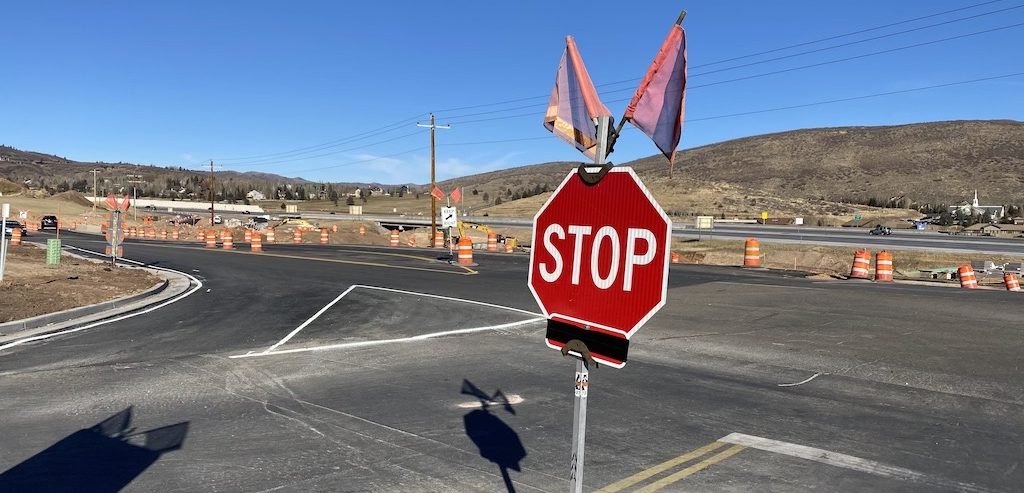
The Jeremy Ranch roundabout construction is the gift that keeps on giving. I was exiting Fresh Market and was stopped. Cars were coming from the roundabout, and I assumed they would stop, because of the stop sign that has been there for months. Except the stop sign is now gone. I pulled out, saw the cars weren’t slowing, and I accelerated to avoid the collision. Now, I assume those other drivers were cursing my name — as they should have been.
Now, I don’t consider myself an idiot, although I’m sure some readers might disagree. I’m generally paying attention and have written quite a bit about the roundabout changes. Yet, I almost caused a big problem.
Why? That’s a damn good question.
Are the roundabouts big with lots of construction going on? Yeah. Has the construction been going on for months? Sure. Is it complicated? Of course? Yet, none of that rings true.
A person from New Jersey chimed in on the roundabout issues and commented that this project was actually better than they had seen in New Jersey.
The comment solidified the issue. The issue isn’t obtrusiveness; it’s the changing rules of the road. One day traffic moves in both directions around the circle. The next day it moves in one way. Some days there is no merging required, and some days, you have to cross lanes to get to your exit. Some days there is a stop sign, and some days there is a yield sign. Some days there is neither.
Oh, and at night, it is pitch black.
In the case of my issue this morning, the stop signs had always been there, but today they weren’t. Now, you could say, “just be observant.” When I circled to see where I messed up, that’s what I thought. “God, I have to be more observant.”
However, then I continued back through the gauntlet and tried to practice that. In some places, there are four or five different points you have to examine mentally in detail if everything can change. Imagine that every four-way stop that you ever came to required that you had to look at each individual intersection, deduce whether there was still a stop sign, whether there was a yield sign, had anything else changed, and nothing you knew before or had become accustomed was guaranteed. You’re no longer a driver; you’re a fighter pilot heading into enemy territory.
For those that don’t drive the Jeremy Roundabout daily, imagine the same scenario on highway 248 headed into Park City. Some days you would drive in the left lane. Some days you would drive in the right lane. Sometimes there would be a four-way stop at Wyatt Earp while other days it would be a one way stop. However, you never know what’s going to happen, so even if you don’t have a stop, you may want to stop. Buffalo Bill may have the right-away some days, and in that case, a yield sign pops up on 228. Otherwise, traffic on 228 can just blow through that intersection.
It’s dangerous.
Any time there is an accident, we as drivers are responsible. Yet whoever designs these changes has culpability. I don’t know if that’s Summit County, UDOT, or the road construction company. We’ll find out if something really goes bad.
We’ll get another chance to embrace change this week when it is all going to change on the Jeremy side.
The sooner this experiment finishes, the better. It’s mentally exhausting.

Parkrag
We believe in citizen journalism. We believe there are stories to tell that can help to shape our community for the better. We believe tomorrow's Park City can be better than today's.